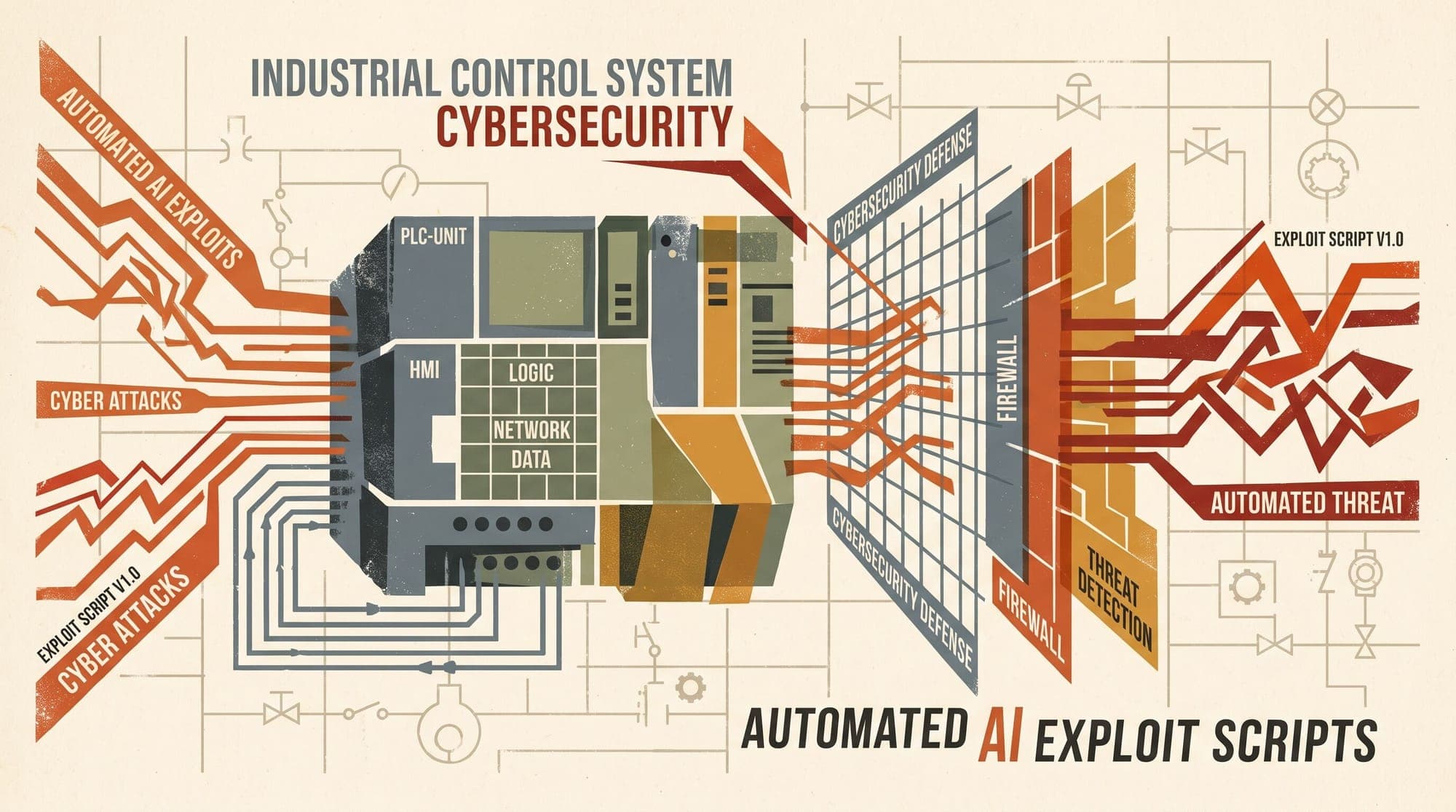
A joint cybersecurity advisory released by the Cybersecurity and Infrastructure Security Agency (CISA), the National Security Agency (NSA), and the Federal Bureau of Investigation (FBI) warns that threat actors are actively leveraging generative AI to develop functional exploit scripts targeting industrial control systems (ICS).
The joint advisory highlights attacks targeting Siemens S7 programmable logic controllers (PLCs), critical hardware widely deployed in energy, water treatment, chemical processing, and industrial manufacturing facilities.
According to federal cyber defense officials, the deployment of large language models for exploit generation represents an operational evolution in threat actor tactics. The technology significantly reduces the technical expertise and development timeline previously required to build working operational technology (OT) payloads.

Automated Reconnaissance and Rapid Scripting
The advisory details how adversaries combine public vulnerability databases with internet scanning tools to identify exposed industrial controllers. Generative AI tools are then used to synthesize functional attack code that directly targets documented PLC weaknesses.
Key findings from the joint agency warning include:
- Lowered Skill Floor: Threat actors with minimal embedded systems experience can generate functional Python and network exploit scripts targeting proprietary industrial protocols.
- Rapid Defense Evasion: Attackers use AI models to quickly adapt attack vectors and modify code structures in response to defensive mitigations and signature-based intrusion detection systems.
- Public Exposure Risks: Industrial controllers directly connected to the internet without proper network segmentation face immediate, automated probing.
The advisory contrasts with prior synthetic benchmark findings. In controlled red-team evaluations conducted by the UK AI Safety Institute, autonomous models struggled to bridge corporate IT networks to reach operational technology hardware without human intervention. However, the current active threat involves human operators using AI tools as accelerated code generators and script synthesizers.
Recommended Mitigations
The federal agencies classify the targeting of industrial controllers as an active threat and urge operators of critical infrastructure to implement immediate defensive controls:
- Strict Network Isolation: Disconnect programmable logic controllers and operational technology networks from the public internet, placing them behind demilitarized zones (DMZs) and air-gapped segments.
- Access Controls: Enforce robust multi-factor authentication (MFA) on all remote access pathways into engineering workstations and SCADA environments.
- Traffic Inspection: Monitor industrial protocol traffic (such as ISO-on-TCP and S7comm) for anomalous commands, unexpected firmware download attempts, and unauthorized ladder logic modifications.