Trump Defends AI Data Center Expansion as Local Resistance Grows

In a broadcast interview on Sunday, President Donald Trump defended the rapid expansion of artificial intelligence data centers across the United States, characterizing municipal and community opposition to new facilities as a significant economic mistake. Speaking on 77 WABC with Michael Cohen, Trump argued that high-density computing infrastructure provides essential local tax revenue, construction employment, and high-tech economic activity. Addressing concerns regarding regional electricity

2 min
Trump Defends AI Data Center Expansion as Local Resistance Grows

In a broadcast interview on Sunday, President Donald Trump defended the rapid expansion of artificial intelligence data centers across the United States, characterizing municipal and community opposition to new facilities as a significant economic mistake.

Speaking on 77 WABC with Michael Cohen, Trump argued that high-density computing infrastructure provides essential local tax revenue, construction employment, and high-tech economic activity. Addressing concerns regarding regional electricity consumption, Trump asserted that the United States maintains a substantial lead over China in artificial intelligence infrastructure, emphasizing that newer hyperscale facilities increasingly invest in dedicated, on-site energy generation to avoid depleting local utility grids.

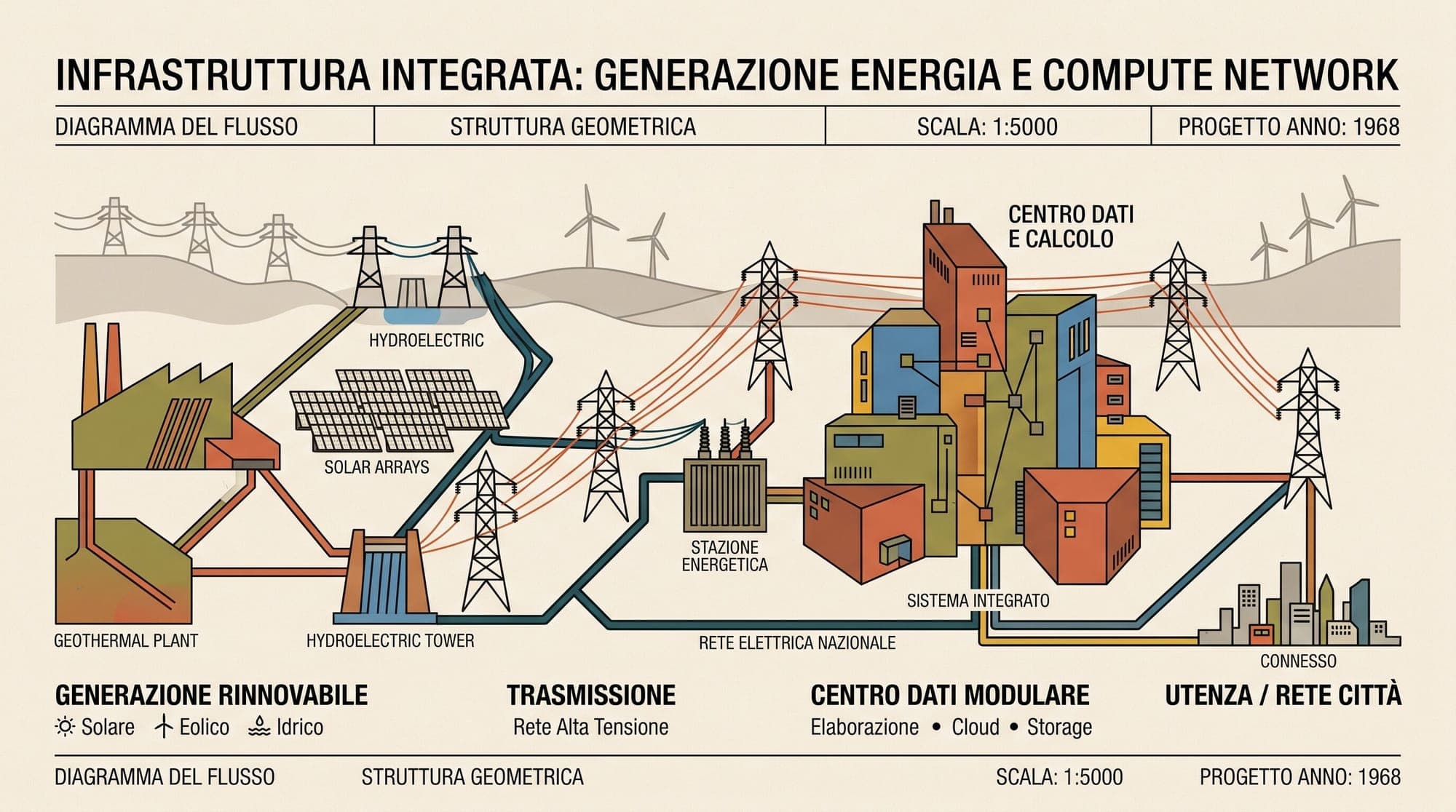
Technical architecture of dedicated on-site power generation for hyperscale compute facilities

State-Level Policy Divergence

Trump's remarks highlight a growing policy split between federal initiatives encouraging rapid compute deployment and state-level regulatory pushback.

Across several key states, local officials have enacted measures to protect ratepayer capacity:

  • Texas: Governor Greg Abbott recently signaled that data center operators have faced justified local resistance after failing to secure community alignment prior to development, mandating that facilities cover their full electrical infrastructure upgrade costs.
  • Pennsylvania: Governor Josh Shapiro signed Executive Order 2026-05, establishing stricter oversight and restrictions on speculative interconnection requests from data center operators.
  • New York: Governor Kathy Hochul enacted a one-year moratorium on new hyperscale data center construction to assess environmental and electrical grid strain.

Federal Permitting and Behind-the-Meter Generation

The administration has sought to accelerate infrastructure rollouts through administrative reforms while mitigating public grid impacts. Recent guidance issued by the Environmental Protection Agency clarified that dedicated power generation systems operating independently of the public grid fall outside the Clean Air Act's Acid Rain Program permitting framework.

Concurrently, federal policy has promoted the Ratepayer Protection Pledge, encouraging hyperscalers to procure or construct dedicated behind-the-meter generation. While off-grid installations reduce strain on municipal distribution systems, the rapid pace of utility interconnection queues continues to serve as a primary bottleneck for domestic compute capacity.


Sources

Written by

More to read

  • RWKV Architecture: How Receptance Weighted Key Value Decay Combines RNN Efficiency with Transformer Parallelizability

    The dominant paradigm in natural language processing relies on the Transformer architecture, which calculates scaled dot-product self-attention across all token pairs in a sequence. While self-attention provides strong in-context retrieval and representation capacity, it imposes quadratic computational and memory complexity, scaling as O(N^2) with sequence length N during training and generating a continuously expanding Key-Value (KV) cache during autoregressive inference. Traditional Recurrent

    1 min
  • Continuous Evaluation and Golden Dataset Curation in Production LLM Systems: Architecture, Log Mining, Synthetic Perturbation, and Semantic Drift Quality Gates

    Continuous Evaluation and Golden Dataset Curation in Production LLM Systems: Architecture, Log Mining, Synthetic Perturbation, and Semantic Drift Quality Gates In production machine learning systems, offline benchmarks suffer from rapid entropy. While engineering teams frequently launch LLM applications backed by static test suites (curated CSVs of 50 to 100 sample prompts, academic benchmarks like MMLU, or synthetic question-answer pairs), these static datasets fail to predict real-world produ

    1 min
  • Kolmogorov-Arnold Networks: How Learnable Edge Splines Challenge the Multi-Layer Perceptron

    Kolmogorov-Arnold Networks: How Learnable Edge Splines Challenge the Multi-Layer Perceptron For over three decades, the foundational building block of deep neural networks has remained essentially unchanged: the Multi-Layer Perceptron (MLP). In standard transformer feed-forward blocks, convolutional networks, and deep classifiers, MLPs alternate linear matrix multiplications ($\mathbf{W}\mathbf{x}$) with fixed, point-wise non-linear activation functions (such as ReLU, GELU, or SwiGLU). Under th

    1 min