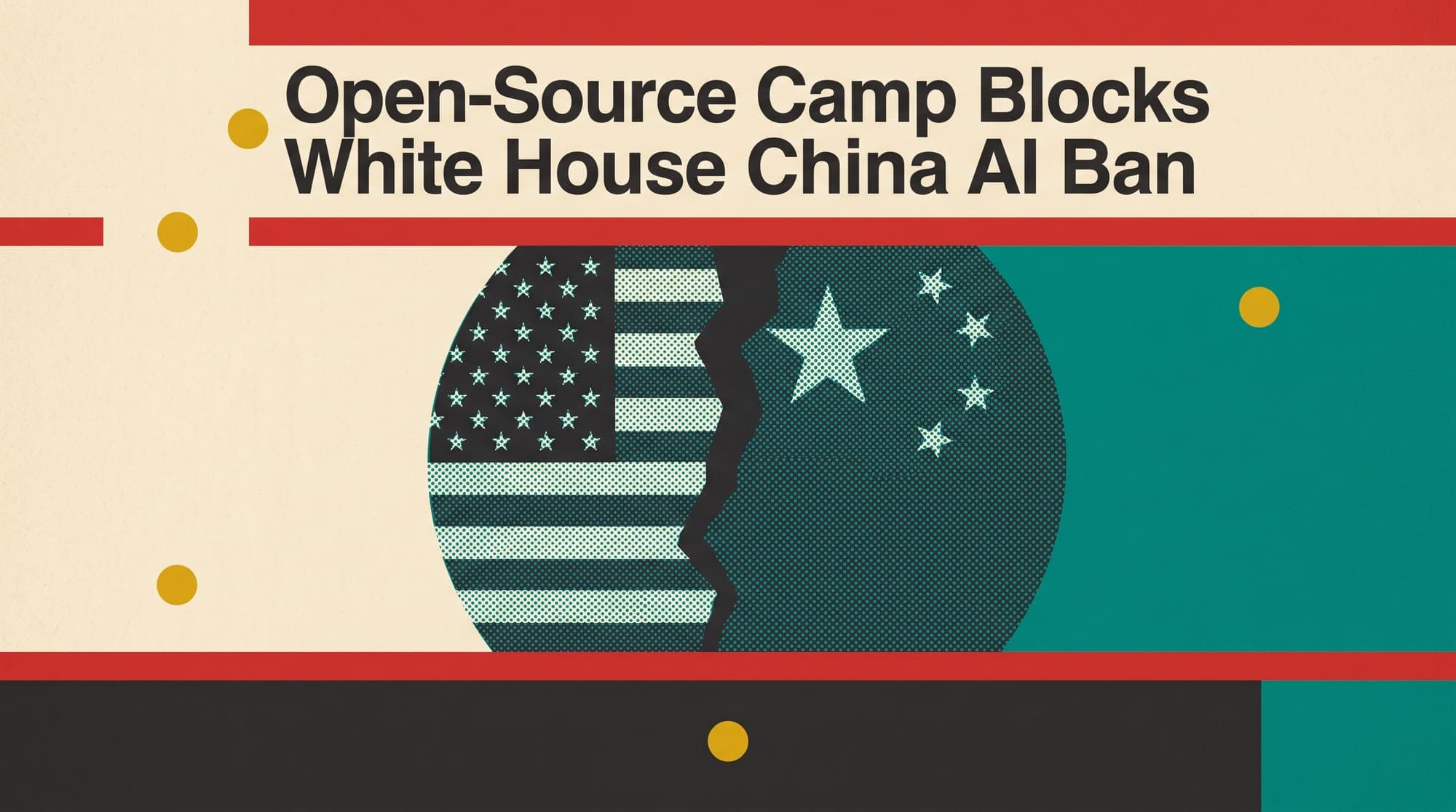
Silicon Valley's Open-Source Camp Blocks White House Push to Ban Chinese AI Models

The Trump administration considered aggressive sanctions, trade blacklists, and cloud-service bans targeting Chinese open-source AI models in recent weeks, before backing off after a coordinated pushback from Nvidia, Meta, Microsoft, and Google, according to New York Times reporting. The internal White House debate, led by Chief of Staff Susie Wiles, Treasury Secretary Scott Bessent, and Commerce Secretary Howard Lutnick, weighed options including sanctions on Chinese makers of open-weigh

2 min
Silicon Valley's Open-Source Camp Blocks White House Push to Ban Chinese AI Models

The Trump administration considered aggressive sanctions, trade blacklists, and cloud-service bans targeting Chinese open-source AI models in recent weeks, before backing off after a coordinated pushback from Nvidia, Meta, Microsoft, and Google, according to New York Times reporting.

The internal White House debate, led by Chief of Staff Susie Wiles, Treasury Secretary Scott Bessent, and Commerce Secretary Howard Lutnick, weighed options including sanctions on Chinese makers of open-weight models and a ban on US cloud providers doing business with those firms. Five sources cited by the Times said the administration also discussed restricting which models federal agencies could use and whether Commerce should impose new export rules.

The confrontation was triggered by the rapid rise of Chinese open models, particularly Moonshot AI's Kimi K3, which now matches top US models across several benchmarks. Michael Kratsios, director of the White House Office of Science and Technology Policy, publicly accused Moonshot of distilling Anthropic's Fable model. Bessent floated sanctions the same day.

The industry response split along predictable lines. OpenAI and Anthropic, both of which keep their models closed, pressed for restrictions by citing national security. On the other side, Nvidia, Microsoft, Google, and Meta argued that open models accelerate innovation and cyber defense and warned that bans would lock in the market position of the two IPO-bound AI labs.

Nvidia CEO Jensen Huang became the most visible counterweight. On July 24, he posted on X for the first time to defend open models. Nvidia also expanded an alliance for open security tools from a handful of members to more than 230.

Christopher Padilla, a former Commerce Department official, told the NYT the dispute was a "cage fight over the future of the AI industry," adding that it was mostly about money and market power with the security angle tacked on.

After the industry outcry, the administration shifted focus to making American models more competitive rather than restricting Chinese ones. Industry officials told the Times they do not expect any hard measures before Chinese President Xi Jinping's scheduled visit in September.

The episode illustrates a widening rift in Silicon Valley over open-weight AI. OpenAI and Anthropic have staked out positions that open models pose unacceptable security risks, while the infrastructure and platform giants whose businesses depend on broad AI adoption see openness as essential.

Sources

Written by

More to read

  • Agent Self-Evolution and Experiential Learning in Production: Trajectory Reflection, Skill Library Curation, and Verifiable Policy Distillation

    Deploying autonomous AI agents into complex environments reveals a persistent operational bottleneck: frozen model weights. When an agent fails at a non-trivial workflow, traditional engineering setups rely on humans to diagnose the failure, rewrite prompt templates, adjust few-shot exemplars, or add custom heuristic wrappers. This manual iteration loop fails to scale across diverse, long-horizon production environments where agents encounter thousands of unique edge cases daily. To break this

    1 min
  • Mistral and HUMAIN Form Multi-Hundred-Million-Euro Sovereign AI Partnership

    Paris-based AI lab Mistral AI and Saudi Arabian state-backed AI firm HUMAIN announced a strategic collaboration on August 24, 2026, valued in the hundreds of millions of euros. The agreement spans regional compute infrastructure access, joint model development, and enterprise deployments across the Middle East. Under the partnership, the two organizations will build localized foundation models with native Arabic-language capabilities, targeting initial production deployments in cybersecurity an

    1 min
  • Temperature Scaling and Model Calibration in Deep Neural Networks: Mathematical Foundations, Expected Calibration Error, and Post-Hoc Logit Optimization

    Modern deep neural networks achieve high classification accuracy and generative benchmark performance across vision, language, and decision-making tasks. However, optimization for raw accuracy does not ensure that predicted softmax probabilities correspond to true posterior probabilities. A model that assigns a 0.90 probability to an output should be correct exactly 90% of the time. When empirical accuracy systematically diverges from predicted confidence, the model is miscalibrated. Research b

    1 min