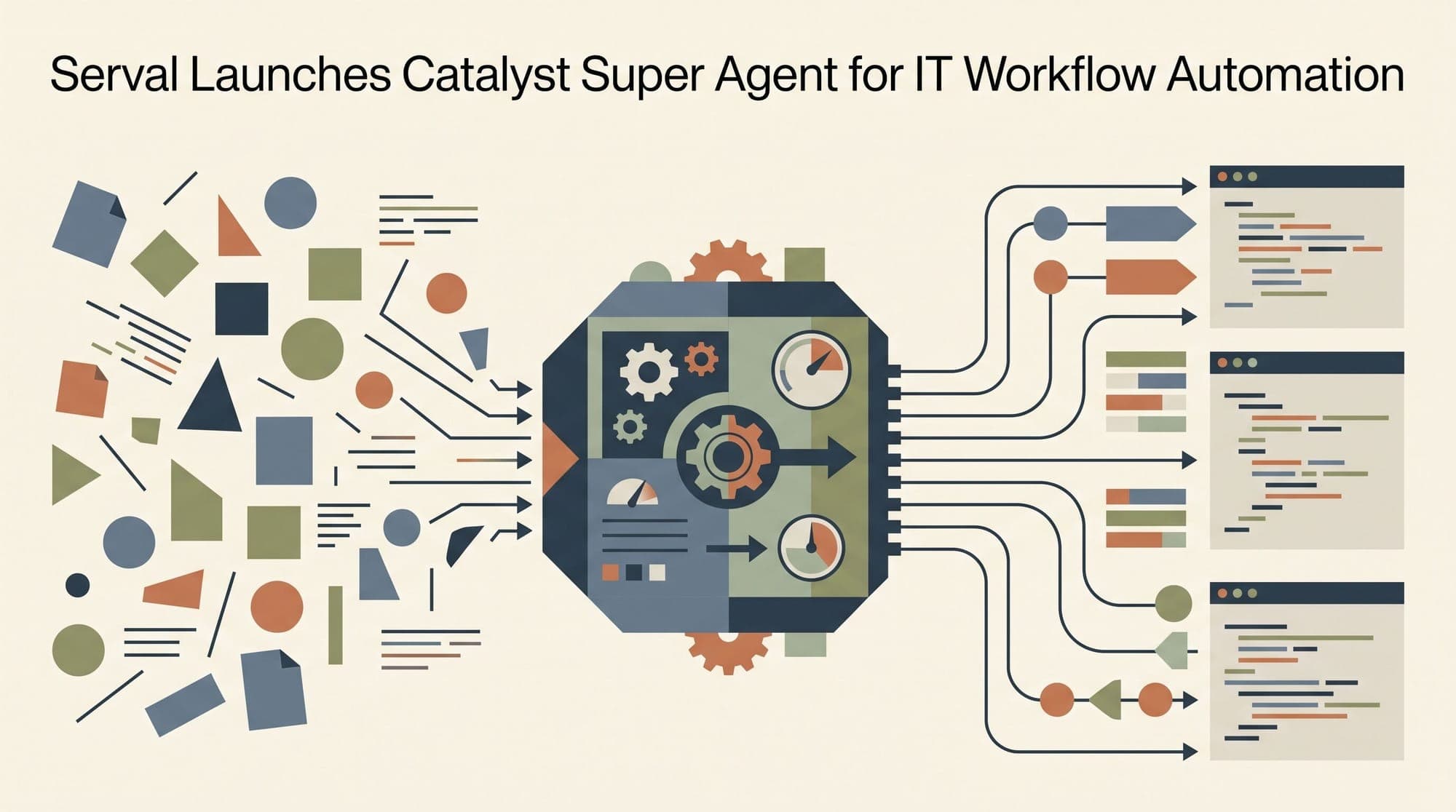
Enterprise service management startup Serval has announced the general availability of Catalyst, an administrative AI agent designed to inspect organizational ticket histories, standard operating procedures, and infrastructure telemetry to generate production IT automations.
The release marks an architectural shift from reactive ticket-triage bots toward end-to-end automation synthesis, enabling organizations to draft executable TypeScript workflows, access policies, and onboarding journeys from natural language descriptions or existing help desk logs.

Automated Workflow Synthesis and Code-Backed Execution
Catalyst operates as an administrative layer across Serval's service platform. By indexing past support requests and documentation, the agent identifies high-volume, repetitive tasks (such as credential resets or identity provisioning) and stages executable workflows for administrator review.
Unlike legacy workflow designers that rely on proprietary rule builders and database tables, Catalyst generates standard TypeScript code. The system connects into enterprise identity systems including Okta, Google Workspace, and Microsoft Entra, constructing the required API interactions, user forms, and role-based access controls automatically.
Proactive Background Agents for Remediation
In addition to user-prompted workflow generation, Catalyst introduces roving background agents that monitor connected IT infrastructure on recurring schedules. These agents correlate multi-source signals (including network switch telemetry, DHCP records, and incident histories) to isolate operational drift before employees submit support tickets.
When an anomaly is detected, the background agent generates a draft remediation workflow and flags it for administrator approval. In customer production environments, this model has been used to isolate cross-office network misconfigurations and resolve just-in-time access provisioning requests without manual IT intervention.
Model-Agnostic Harness Architecture
Serval's technical architecture relies on a multi-model harness rather than proprietary foundation models:
- Conversational Interaction and Tool Calling: Serval utilizes OpenAI GPT models to process end-user requests, parse ambiguous instructions, and manage parameter extraction.
- Code Generation and Policy Synthesis: The platform routes workflow generation, TypeScript authoring, and schema drafting to Anthropic's Sonnet and Opus models.
- Custom Endpoints and BYO Keys: Enterprise administrators can provide custom API keys or route requests to self-hosted endpoints, retaining data ownership and compliance boundaries.
The company positions this architecture as a direct challenge to established IT service management platforms such as ServiceNow, Atlassian Jira Service Management, and Freshworks. Founded in 2024 by former Verkada leaders Jake Stauch and Alex McLeod, Serval raised a $75 million Series B led by Sequoia Capital at a $1 billion valuation in late 2025, bringing its total funding to approximately $127 million.