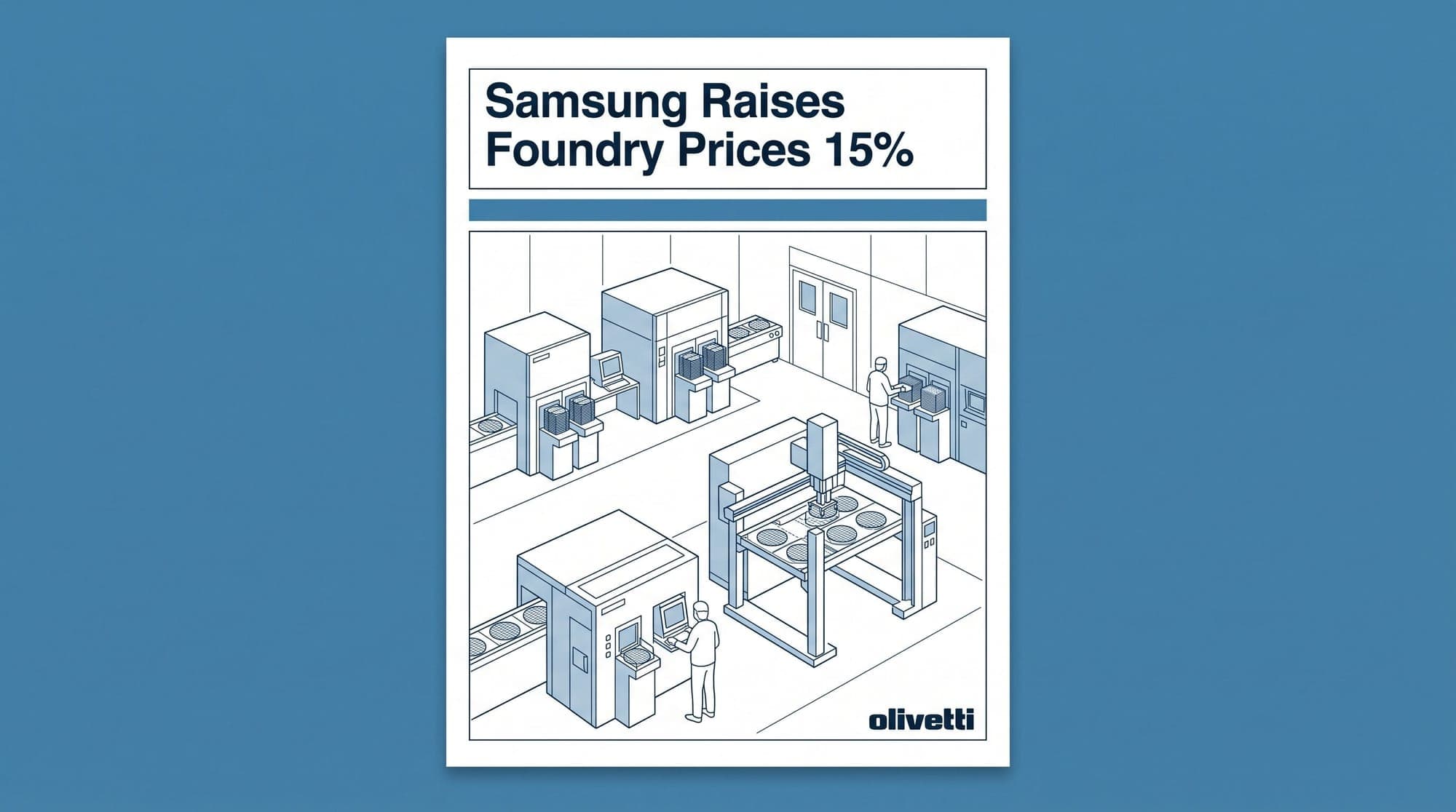
Samsung Raises 4nm and 5nm Foundry Prices up to 15% on AI Chip Demand

Samsung Electronics has raised prices for its most advanced contract chipmaking services by up to 15 percent for new orders, according to two sources familiar with the matter, as demand for AI chips tightens capacity at the South Korean foundry. The increases apply to Samsung's 4-nanometer SF4 and 5-nanometer SF5 process nodes. Prices for SF4 wafers rose 10 to 15 percent for customers in China and the United States from the previous month, while customers in Taiwan saw increases of 5 to 10 perc

1 min
Samsung Raises 4nm and 5nm Foundry Prices up to 15% on AI Chip Demand

Samsung Electronics has raised prices for its most advanced contract chipmaking services by up to 15 percent for new orders, according to two sources familiar with the matter, as demand for AI chips tightens capacity at the South Korean foundry.

The increases apply to Samsung's 4-nanometer SF4 and 5-nanometer SF5 process nodes. Prices for SF4 wafers rose 10 to 15 percent for customers in China and the United States from the previous month, while customers in Taiwan saw increases of 5 to 10 percent. SF5 wafer prices increased 10 to 15 percent, and the older 8-nanometer process rose nearly 10 percent.

The SF4 line at Samsung's Pyeongtaek plant has run at full capacity since late 2025, one source said. Chinese customers have faced particularly steep increases, reflecting how U.S. export controls on advanced chipmaking equipment have increased Chinese firms' reliance on overseas foundries. Samsung must also balance serving U.S. customers and reserving capacity for its own memory chip production.

Samsung captured roughly 7 percent of global foundry revenue in the first quarter of 2026, according to Counterpoint Research, compared with TSMC's dominant share. The price hikes mark a turnaround for Samsung's foundry business, which had operated at a loss since 2022 according to industry estimates.

The move follows TSMC's notification to major clients including Nvidia, Apple, and AMD of planned 5 to 10 percent wafer price increases across 3nm, 5nm, and 7nm processes. Analysts characterize Samsung's approach as normalizing prices on nodes where demand is concentrated, rather than the broad increases TSMC is pursuing.

Sources

  • Reuters, "Samsung hikes chipmaking prices by up to 15% on demand spike, sources say," August 19, 2026
  • Reuters, "TSMC, Samsung raise foundry prices as AI demand shifts market," July 9, 2026

Written by

More to read

  • Decentralized and Peer-to-Peer LLM Inference in Production: Architecture, Ring Memory Partitioning, and Network Latency

    Decentralized and Peer-to-Peer LLM Inference in Production: Architecture, Ring Memory Partitioning, and Network Latency Frontier open-weight models such as Llama 3.1 405B, DeepSeek-V3, and Command R+ have expanded model capabilities, but their parameter scales exceed the physical memory limits of individual consumer and edge workstations. Running a 405-billion parameter model in 16-bit precision requires over 810 GB of memory, and even 4-bit quantized variants require roughly 230 GB of contiguo

    1 min
  • Discrete Diffusion in Large Language Models: How Continuous-Time Markov Chains, Absorbing States, and Score Entropy Challenge Autoregressive Generation

    The dominance of autoregressive architectures in large language models rests on a fundamental mathematical formulation: the chain rule of probability. By factoring the joint distribution of a sequence into a product of conditional probabilities, $p(x) = \prod_{i=1}^N p(x_i \mid x_{<i})$, autoregressive models reduce text generation to sequential next-token prediction. While this left-to-right causal factorization has scaled effectively across compute regimes, it imposes rigid operational constr

    1 min
  • AI Agents Surpass Humans on OpenRouter as Agentic Token Usage Jumps 14x

    Autonomous AI agents have overtaken human users as the primary consumers of language model compute on OpenRouter, with agentic token volume surging fourteenfold over the past six months. Data published by OpenRouter analyst Peter Walker indicates that February 6 marked the permanent inflection point where token consumption by automated agents exceeded direct human API traffic. Since that threshold, agentic token volume on the multi-model gateway has climbed from 0.51 trillion to 7.3 trillion to

    1 min