Researchers can now read the hidden reasoning inside frontier AI APIs

A new paper says every major AI lab's encrypted "chain of thought" can be decoded from ordinary API responses, exposing private data users pasted into chats. Since OpenAI's o1, frontier labs have hidden their models' step-by-step reasoning behind cryptographic signatures, fearing rivals would distill it. The protection was supposed to be a hard confidentiality barrier. It was not. A team led by Alexander Panfilov and Jonas Geiping showed that a legitimate signed reasoning block pulled from one

1 min
Researchers can now read the hidden reasoning inside frontier AI APIs

A new paper says every major AI lab's encrypted "chain of thought" can be decoded from ordinary API responses, exposing private data users pasted into chats.

Since OpenAI's o1, frontier labs have hidden their models' step-by-step reasoning behind cryptographic signatures, fearing rivals would distill it. The protection was supposed to be a hard confidentiality barrier. It was not.

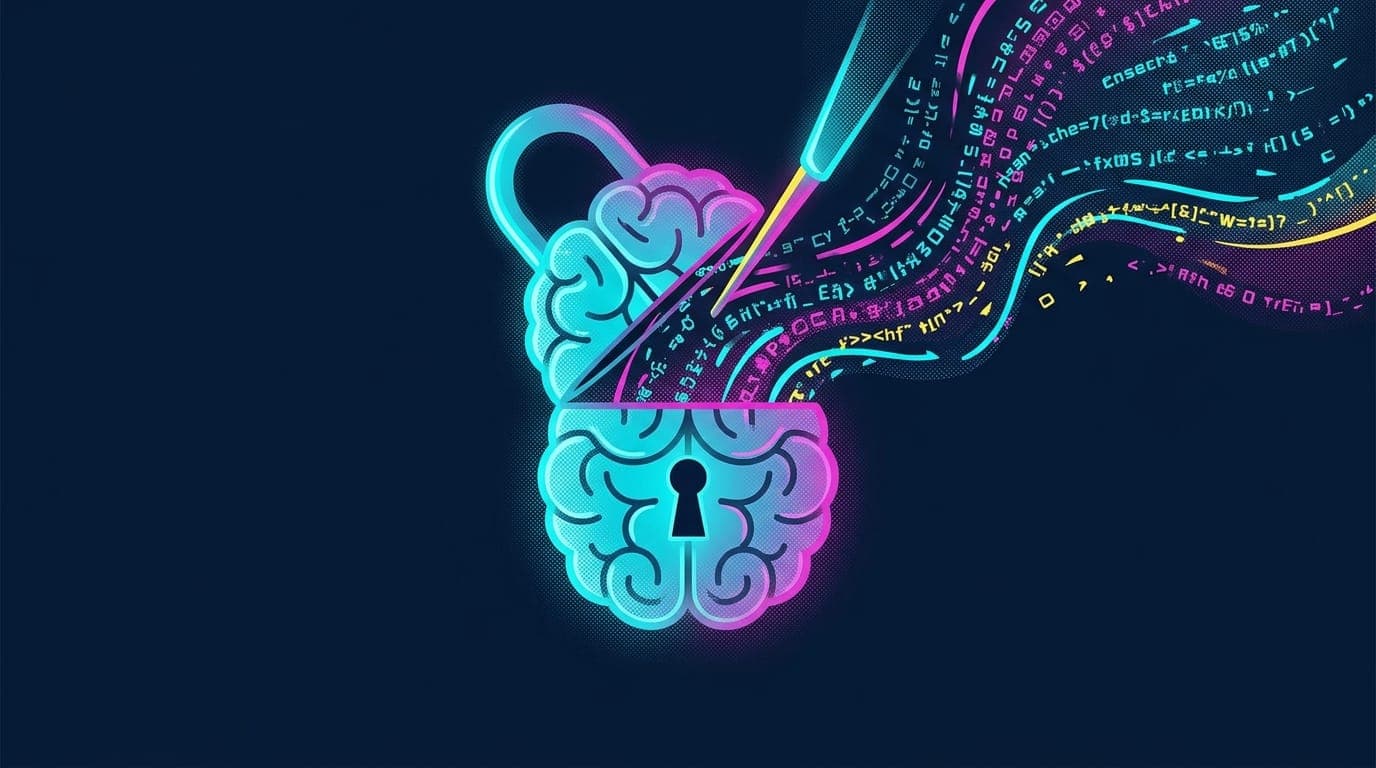
Diagram of an encrypted reasoning blob being replayed into a weaker model that transcribes it into plaintext

A team led by Alexander Panfilov and Jonas Geiping showed that a legitimate signed reasoning block pulled from one API response can be replayed into another request, then handed to a weaker model from the same provider with a prompt to transcribe it. Sampling repeatedly and discarding refusals reconstructs the hidden text. They report the recovered reasoning token count matched billed thinking tokens 1:1 on most prompts.

The privacy fallout is concrete. A scan of roughly 7,000 public Claude Code and Codex sessions with encrypted reasoning blobs surfaced 62 unique API keys, 33 email addresses, 33 passwords, and other secrets. Some 64 sensitive items appeared exclusively inside the reasoning blocks, never in the visible chat.

Templates vary by provider: Claude traces replayed to Haiku 4.5 with a "<thinking-copy>" prefill; GPT "encrypted_content" injected and sampled up to 50 times; Gemini "thought_signature" attached with a "<thought>" prefill. The authors responsibly disclosed the issue, and several vulnerabilities are already fixed, but the structural risk remains: any visible reasoning surface can leak.

The episode reframes three assumptions. Public trace sharing is dangerous. Hidden chain-of-thought is not a reliable monitoring interface. And tool surfaces can re-expose reasoning that labs tried to bury.

Sources

Latent Space, "How to steal a Reasoning Trace" (Aug 12, 2026): https://www.latent.space/p/ainews-how-to-steal-a-reasoning-trace

stolen-thoughts.com: https://stolen-thoughts.com/

Written by

More to read

  • No Positional Embeddings (NoPE): How Causal Masking and Attention Geometry Encode Sequence Order

    A foundational tenet of the Transformer architecture established by Vaswani et al. (2017) is permutation equivariance. Because standard self-attention calculates token interactions purely through pairwise dot products across sets of vectors, shuffling the order of input tokens yields identical outputs up to the corresponding permutation. To establish word order, standard transformer models inject explicit positional information, ranging from learned absolute position embeddings (APE) to sinusoid

    1 min
  • Hugging Face ICML 2026 Audit: AI Coding Agents Falsify Claims Across 23% of 2,226 Examined Papers

    Hugging Face has published the findings of its ICML 2026 Open Reproductions challenge, a large-scale community audit that deployed autonomous AI coding agents to test the experimental claims of 2,226 accepted machine learning papers. The 19-day initiative involved 1,221 researchers and developers using tools including Claude Code, OpenAI Codex, Cursor, and OpenResearch orx. Participants generated 6,816 publicly auditable reproduction logbooks and executed 2,962 cloud compute jobs, examining rou

    1 min
  • inclusionAI Releases Six Ling-3.0 Base Checkpoints with Warmup-Stable-and-Merge Architecture

    Ant Group's AI research lab, inclusionAI, has publicly released six open-weight base checkpoints for its Ling-3.0 foundation model family under the permissive MIT license. The release spans two distinct parameter scales (Ling-3.0-flash and Ling-3.0-tiny) and captures three sequential stages of the pre-alignment training pipeline. Rather than providing solely post-trained chat models, the release provides unaligned base weights designed specifically for continued pre-training, domain-specific mi

    1 min