OpenAI Gains on Anthropic in Corporate AI Spending, Ramp Data Shows

Corporate card and spend-management platform Ramp released updated enterprise purchasing data indicating that OpenAI is growing faster than Anthropic among US businesses in the third quarter of 2026, closing the gap after losing the top spot earlier in the year. The metrics, compiled from transaction data across more than 70,000 businesses using Ramp corporate cards and invoice processing, highlight ongoing volatility in enterprise model selection. Market Share Trajectory and Model Drivers A

1 min
OpenAI Gains on Anthropic in Corporate AI Spending, Ramp Data Shows

Corporate card and spend-management platform Ramp released updated enterprise purchasing data indicating that OpenAI is growing faster than Anthropic among US businesses in the third quarter of 2026, closing the gap after losing the top spot earlier in the year.

The metrics, compiled from transaction data across more than 70,000 businesses using Ramp corporate cards and invoice processing, highlight ongoing volatility in enterprise model selection.

Market Share Trajectory and Model Drivers

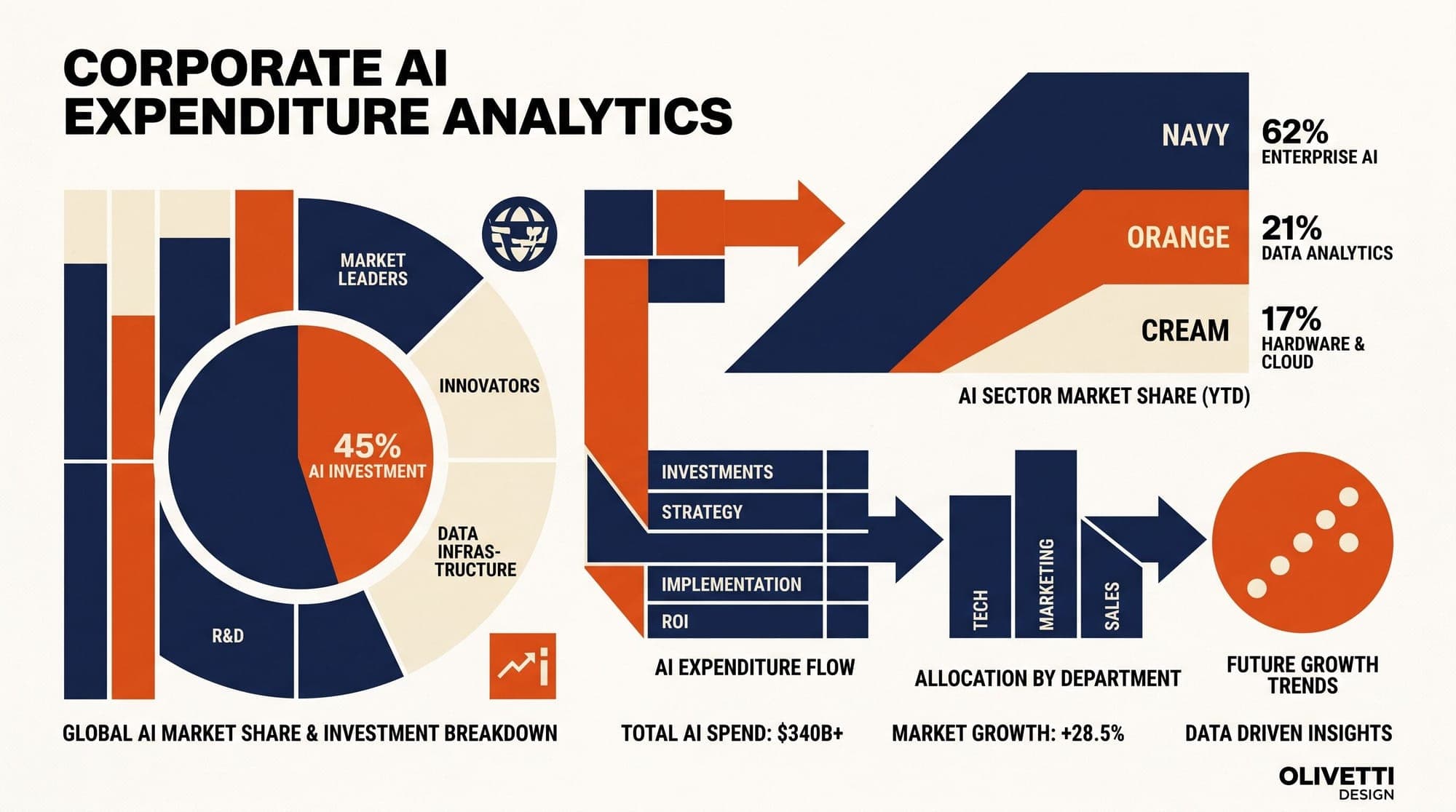
Anthropic overtook OpenAI in business adoption on Ramp's platform in May 2026, capturing 41% market share compared to OpenAI's 39.5%. By July, Anthropic maintained a lead of roughly 44% against OpenAI's 40%.

Enterprise model selection dynamics and cost retention tradeoffs

According to Ramp lead economist Ara Kharazian, OpenAI's Q3 rebound is primarily driven by developer traction around its GPT-5.6 Sol model. Conversely, Anthropic's high-tier Fable 5 model faced adoption headwinds due to premium pricing structures and mandatory 30-day data retention requirements imposed by regulatory agreements.

Broadening Enterprise Penetration

While the two providers trade market share, overall corporate AI investment continues to climb across mid-market and tech-forward organizations:

  • Overall Adoption: The share of Ramp customer companies paying for AI subscriptions reached nearly 56% in July 2026, up from 50% in March.
  • Provider Volatility: Organizations continue to switch primary model providers quickly in response to checkpoint releases and price-performance shifts.
  • Scope Limitations: Ramp's dataset reflects direct card and invoice spend, excluding multi-year enterprise volume commitments through hyperscaler cloud agreements such as Microsoft Azure or AWS Bedrock.

Sources

Written by

More to read

  • Weight Tying in Large Language Models: Mathematical Foundations, Geometric Bottlenecks, and Modern Architectural Trade-Offs

    Weight Tying in Large Language Models: Mathematical Foundations, Geometric Bottlenecks, and Modern Architectural Trade-Offs In autoregressive language models, the embedding layer at the input and the unembedding projection layer at the output serve as the two bridges between discrete vocabulary tokens and the continuous hidden representation space. In the foundational Transformer architecture (Vaswani et al., 2017) and early generative models like GPT-2 (Radford et al., 2019), the weights of th

    1 min
  • Anthropic Launches Claude Academy and 4D AI Fluency Framework for Workforce Training

    Anthropic has launched Claude Academy, an interactive training platform aimed at standardizing how individuals and enterprise teams learn, deploy, and evaluate AI systems. Available via academy.claude.com and directly inside the Claude profile interface, the program couples tool-specific training modules with a foundational curriculum designed to cultivate systematic AI interaction patterns. The initiative comes as enterprise adoption shifts from ad-hoc prompting toward autonomous agent workflo

    1 min
  • Semantic Drift and Data Distribution Monitoring in Production LLM Systems: Embedding Shift Detection, Output Entropy Tracking, and Quality Decay Metrics

    Semantic Drift and Data Distribution Monitoring in Production LLM Systems: Embedding Shift Detection, Output Entropy Tracking, and Quality Decay Metrics Large language model applications rarely fail with loud runtime crashes once deployed. Instead, production systems suffer from silent performance decay caused by data distribution shifts. User queries evolve, real-world domain vocabularies change, retrieval corpora expand, and upstream model providers quietly alter model weights or system promp

    1 min