Nvidia and Amazon channel billions into AI power infrastructure

Nvidia and Amazon are putting serious money into the power generation needed to keep AI data centers running, with two separate deals announced this week that underscore how energy has become a bottleneck for the industry. Nvidia is investing up to $3 billion in Lancium, the power infrastructure developer behind the OpenAI and Oracle data center in Texas, according to The Information. A roughly $2 billion stake would give Nvidia about 20 percent of the company, which is valued at around $10 bil

2 min
Nvidia and Amazon channel billions into AI power infrastructure

Nvidia and Amazon are putting serious money into the power generation needed to keep AI data centers running, with two separate deals announced this week that underscore how energy has become a bottleneck for the industry.

Nvidia is investing up to $3 billion in Lancium, the power infrastructure developer behind the OpenAI and Oracle data center in Texas, according to The Information. A roughly $2 billion stake would give Nvidia about 20 percent of the company, which is valued at around $10 billion. Lancium already has four gigawatts of power under contract in Texas and is developing sites for up to 15 more gigawatts.

Amazon, meanwhile, is backing a massive gas-fired power plant in Pecos County, Texas, to supply one of its own data centers. The facility could emit up to 33 million tons of CO2 per year, according to the New York Times, which would make it the dirtiest power plant in the country. Its 35 gas turbines are designed to generate up to 7.65 gigawatts of electricity.

Why power is the constraint

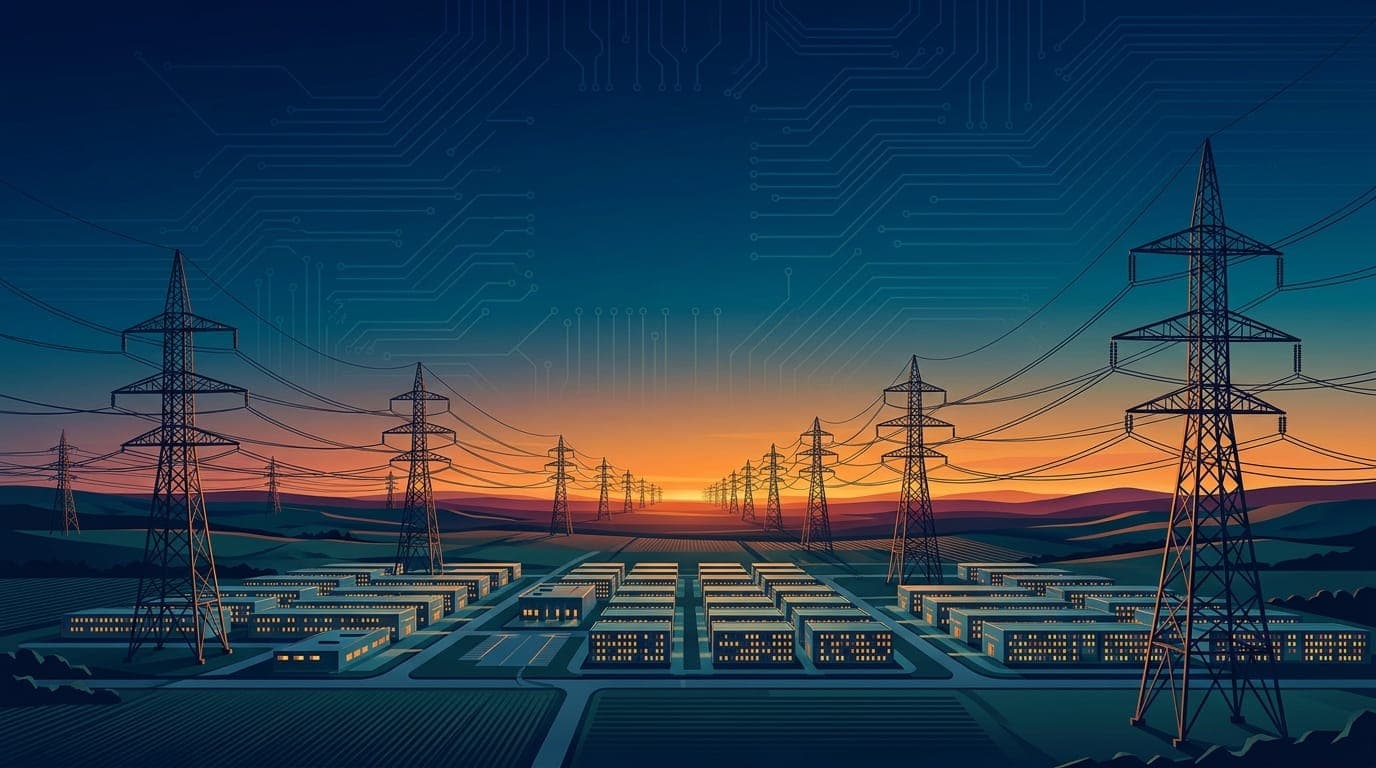
Editorial infographic comparing Nvidia's investment in Lancium power infrastructure with Amazon's Texas gas-fired power plant

The deals reflect a broader shift in the AI industry, where compute capacity is no longer the only limit on scale. Agentic AI workloads are dramatically more energy-hungry than simple chat prompts. Climate scientist Zeke Hausfather estimates that a heavy user of agentic AI burns about as much energy per year as a clothes dryer, and that figure is climbing.

Amazon spokesperson Margaret Callahan said the company's climate goals still stand but acknowledged that AI data centers could make hitting them harder. Environmental groups are raising alarms about health and pollution risks from the Texas facility.

The numbers are a reminder that AI expansion now depends on the power grid as much as on chips and model architecture. Both Nvidia and Amazon are effectively betting billions on the assumption that demand for AI compute will keep growing fast enough to justify the infrastructure.

Sources

AI's energy appetite drives Nvidia and Amazon to pour billions into massive power infrastructure (The Decoder, Aug 9, 2026): https://the-decoder.com/ais-energy-appetite-drives-nvidia-and-amazon-to-pour-billions-into-massive-power-infrastructure/

Nvidia to invest up to $3 billion in Blackstone-backed power firm behind Stargate (The Information): https://www.theinformation.com/articles/nvidia-to-invest-up-to-3-billion-in-blackstone-backed-power-firm-behind-stargate

Amazon data center and a record-setting polluting power plant in Texas (New York Times, Aug 8, 2026): https://www.nytimes.com/2026/08/08/climate/amazon-data-center-texas-pollution.html


Written by

More to read

  • Decentralized and Peer-to-Peer LLM Inference in Production: Architecture, Ring Memory Partitioning, and Network Latency

    Decentralized and Peer-to-Peer LLM Inference in Production: Architecture, Ring Memory Partitioning, and Network Latency Frontier open-weight models such as Llama 3.1 405B, DeepSeek-V3, and Command R+ have expanded model capabilities, but their parameter scales exceed the physical memory limits of individual consumer and edge workstations. Running a 405-billion parameter model in 16-bit precision requires over 810 GB of memory, and even 4-bit quantized variants require roughly 230 GB of contiguo

    1 min
  • Discrete Diffusion in Large Language Models: How Continuous-Time Markov Chains, Absorbing States, and Score Entropy Challenge Autoregressive Generation

    The dominance of autoregressive architectures in large language models rests on a fundamental mathematical formulation: the chain rule of probability. By factoring the joint distribution of a sequence into a product of conditional probabilities, $p(x) = \prod_{i=1}^N p(x_i \mid x_{<i})$, autoregressive models reduce text generation to sequential next-token prediction. While this left-to-right causal factorization has scaled effectively across compute regimes, it imposes rigid operational constr

    1 min
  • AI Agents Surpass Humans on OpenRouter as Agentic Token Usage Jumps 14x

    Autonomous AI agents have overtaken human users as the primary consumers of language model compute on OpenRouter, with agentic token volume surging fourteenfold over the past six months. Data published by OpenRouter analyst Peter Walker indicates that February 6 marked the permanent inflection point where token consumption by automated agents exceeded direct human API traffic. Since that threshold, agentic token volume on the multi-model gateway has climbed from 0.51 trillion to 7.3 trillion to

    1 min