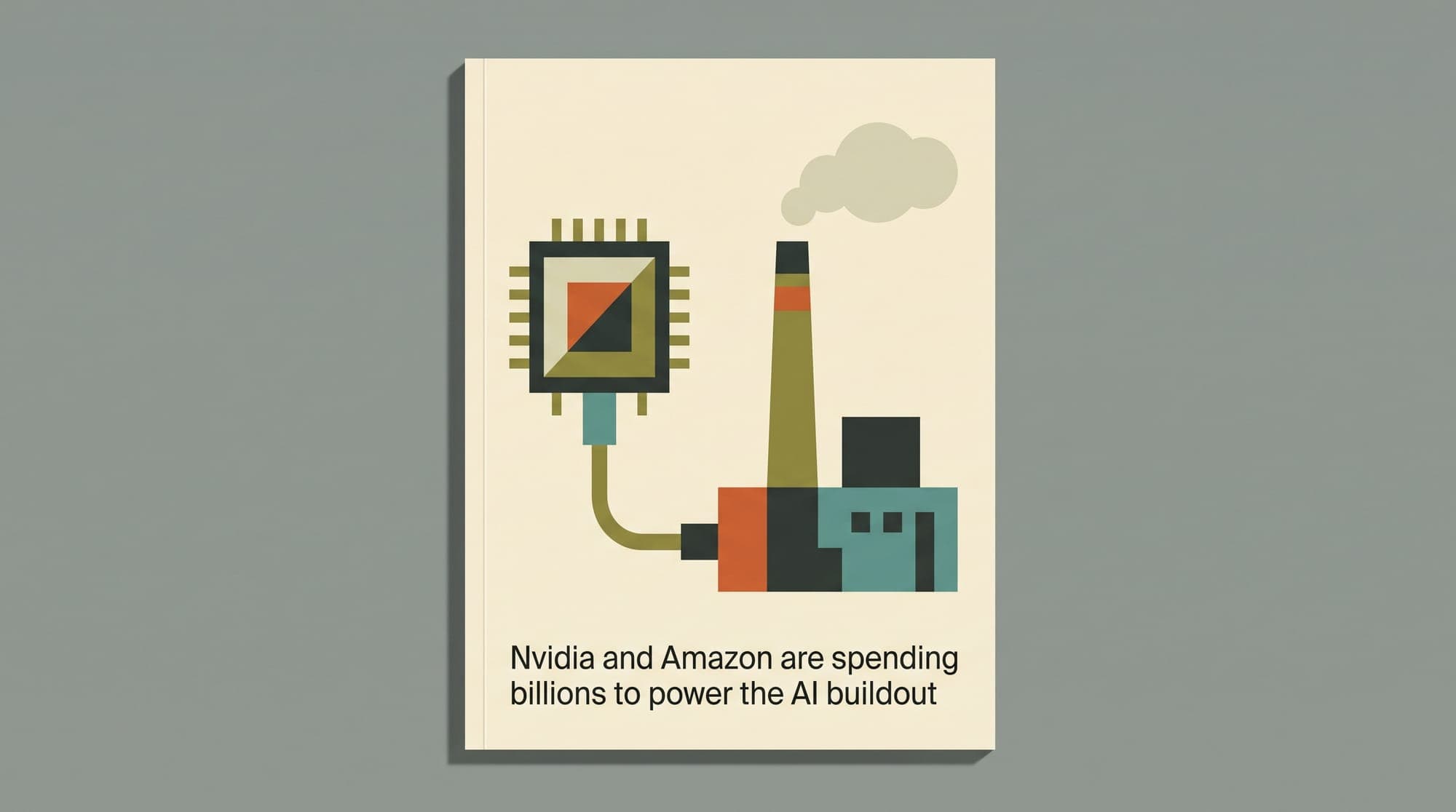
Nvidia and Amazon are spending billions to power the AI buildout

Nvidia and Amazon are spending billions to power the AI buildout The AI boom has outgrown the grid. Nvidia and Amazon are now putting billions of dollars into power generation and infrastructure, with consequences for both the supply chain and the climate. Nvidia is investing up to $3 billion in Lancium, the power-infrastructure developer behind the OpenAI-Oracle Stargate site in Texas, according to The Information. A $2 billion stake would give Nvidia roughly 20 percent of a company valued at

2 min
Nvidia and Amazon are spending billions to power the AI buildout

Nvidia and Amazon are spending billions to power the AI buildout

The AI boom has outgrown the grid. Nvidia and Amazon are now putting billions of dollars into power generation and infrastructure, with consequences for both the supply chain and the climate.

Nvidia is investing up to $3 billion in Lancium, the power-infrastructure developer behind the OpenAI-Oracle Stargate site in Texas, according to The Information. A $2 billion stake would give Nvidia roughly 20 percent of a company valued at about $10 billion. Lancium already has four gigawatts of power under contract in Texas and is developing sites for up to 15 more gigawatts.

Amazon is going further downstream. It is backing a gas-fired plant in Pecos County, Texas, designed to feed up to 7.65 gigawatts to an Amazon data center through 35 gas turbines. The New York Times reports the facility could emit up to 33 million tons of CO2 a year, which would make it the dirtiest power plant in the United States. Amazon spokesperson Margaret Callahan said the company's climate goals still stand but acknowledged that AI data centers could make them harder to hit.

The scale reflects how quickly compute demand is outpacing the grid. Climate scientist Zeke Hausfather estimates that a heavy user of agentic AI burns roughly the same energy per year as a clothes dryer, and that figure keeps climbing as agents take on more tasks.

The investments show where the money is flowing in the AI race: not just chips, but the electricity to run them. Nvidia's move into power infrastructure also tightens its grip on the entire stack, from silicon to the watt.

Sources

Written by

More to read

  • Hybrid SSM-Transformer Architectures: How Interleaving Attention and Recurrence Solves the State-Retrieval Trade-Off

    Hybrid SSM-Transformer Architectures: How Interleaving Attention and Recurrence Solves the State-Retrieval Trade-Off Autoregressive language models face a fundamental tension between inference efficiency and long-context retrieval capacity. Pure Transformer architectures scale quadratic computational complexity during sequence prefill and linear key-value (KV) cache memory consumption during autoregressive token generation. Conversely, pure State Space Models (SSMs) and linear recurrent neural

    1 min
  • Study: Why Labor-Saving LLMs Incline Scientists to Do More Work Less Well

    A theoretical study published by researchers from Princeton University, the University of Washington, and collaborating institutions models how large language models alter researchers' time allocation across projects. The authors find that by reducing time friction across different stages of the research lifecycle, AI assistants increase the opportunity cost of researcher time, creating economic incentives to publish a higher volume of less thoroughly refined papers. The paper, titled The unint

    1 min
  • Memory Shortage Drives Nvidia AI Server Prices Up Over 15%

    Nvidia has notified major customers that prices for server systems containing its artificial intelligence accelerators are increasing by more than 15% in many configurations, according to reports from Bloomberg and Fortune. The price adjustments stem from severe supply constraints and rising costs across dynamic random-access memory (DRAM) and high-bandwidth memory (HBM) modules. The price increases will apply to server systems scheduled for delivery starting in early 2027, covering platforms p

    1 min