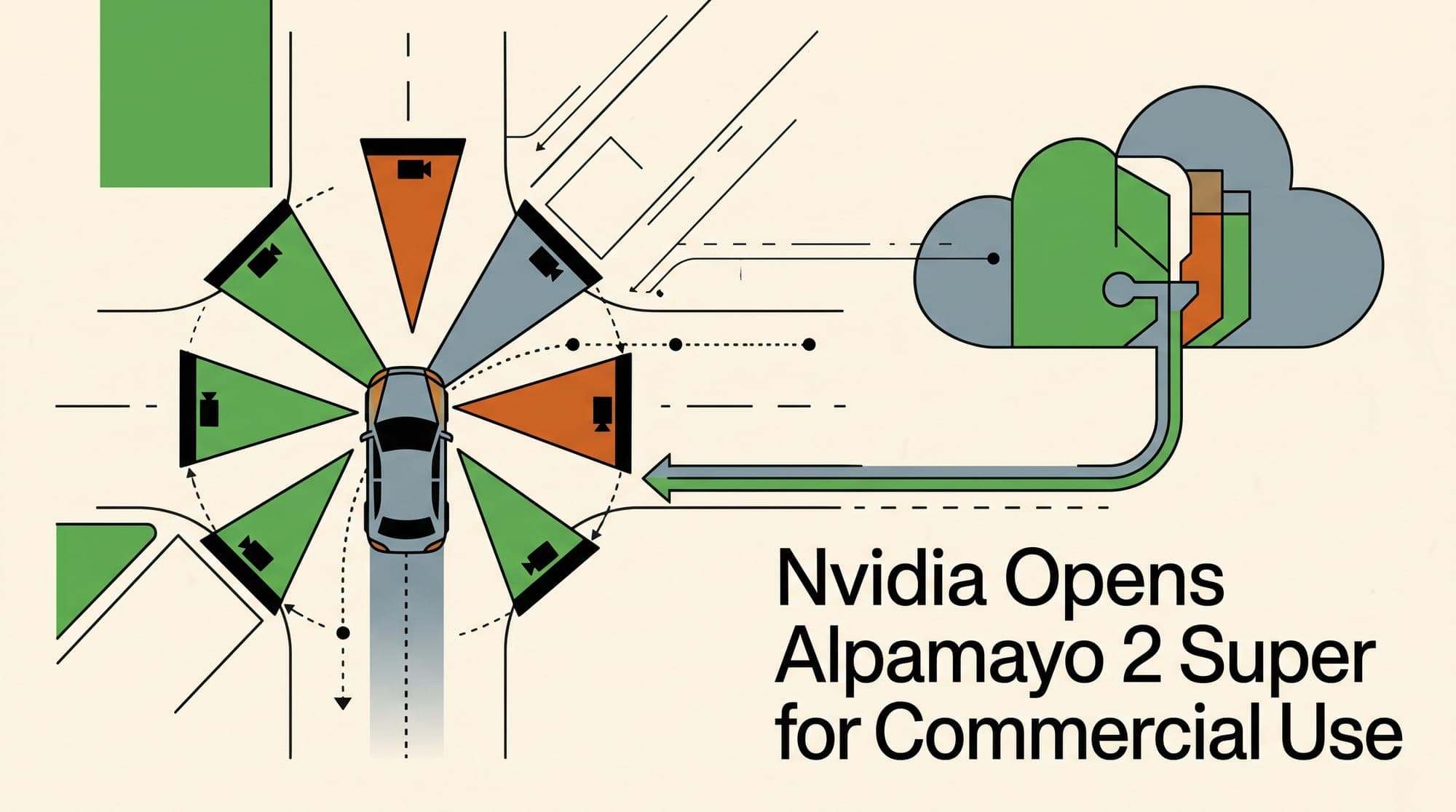
Nvidia has released the weights for Alpamayo 2 Super, a 34-billion-parameter vision-language-action model for autonomous-vehicle development, under the Linux Foundation's OpenMDW-1.1 license. The change gives automakers and autonomous-driving developers a commercial path to fine-tune, redistribute, and build derivative models from Nvidia's largest Alpamayo release, according to the company's announcement and model card.
A cloud teacher model, not a robotaxi driver
Alpamayo 2 Super combines a 32-billion-parameter vision-language backbone with a 2.3-billion-parameter diffusion action decoder. It takes synchronized multi-camera images or video, text, and vehicle motion history, then produces planned trajectories alongside chain-of-causation explanations, high-level driving actions, grounded visual answers, and generated labels for training data, according to the Hugging Face model card.
The model is intended primarily for cloud development workflows rather than direct deployment inside a production vehicle. Nvidia describes it as a teacher model that can generate reasoning traces, synthetic labels, and outputs for distillation into smaller models suited to real-time automotive hardware. The published implementation has been tested on one H100 GPU with 80GB of memory; Nvidia reports peak device memory of about 72GB in its measured seven-camera configuration, and says other GPU architectures have not yet been validated in the model card.
That distinction matters. The release does not place a downloadable robotaxi stack on the road. It supplies a large development model for perception, planning, labeling, evaluation, and knowledge distillation, with production deployment still requiring system-level validation and smaller runtime components.
Commercial rights across the Alpamayo family
Earlier Alpamayo releases arrived for research and development. Nvidia says it is applying OpenMDW-1.1 across the full family, allowing developers to move from adaptation to commercial deployment without seeking a separate license. The license permits use of the model materials without restriction, subject to retaining the license and applicable origin notices when distributing them. It also includes a patent and copyright litigation termination clause, according to the OpenMDW-1.1 text.
For autonomous-driving teams, the practical advantage is control over proprietary fleet data and derivative models. A company can fine-tune Alpamayo within its own infrastructure, use it to label driving footage, and distill its outputs into an in-vehicle model while keeping that work inside its deployment pipeline, Nvidia says in the release announcement.
Nvidia's benchmark claims need the usual qualifier
Nvidia reports a Lingo-Judge score of 79.2 on the LingoQA autonomous-driving reasoning benchmark. In its own evaluation, the company says Alpamayo 2 Super beat Qwen2.5-VL 72B by 17 points, Gemini 2.5 Pro by 15.1 points, and GPT-4o by 23.2 points. These comparisons come from Nvidia rather than an independent evaluator, as shown in the company announcement and model card.
The model was trained with roughly 115,000 hours of multi-camera driving video and about 3.7 million chain-of-causation traces. Its published evaluations also include 910 closed-loop simulator scenarios and 937 challenging open-loop samples, according to the model card.
The licensing move is the more concrete development. Alpamayo's model weights can now be used commercially, but Nvidia's own documentation still warns that integration into autonomous-driving systems requires use-case-specific testing and iterative safety validation before deployment.