title: "Neural Tangent Kernel: How Infinite-Width Networks Linearize Gradient Descent" slug: "neural-tangent-kernel-how-infinite-width-networks-linearize-gradient-descent" feature_image: "https://cms.llms.blog/content/images/2026/08/neural-tangent-kernel-cover.png" tags: ["edu", "theory", "foundations"] status: published
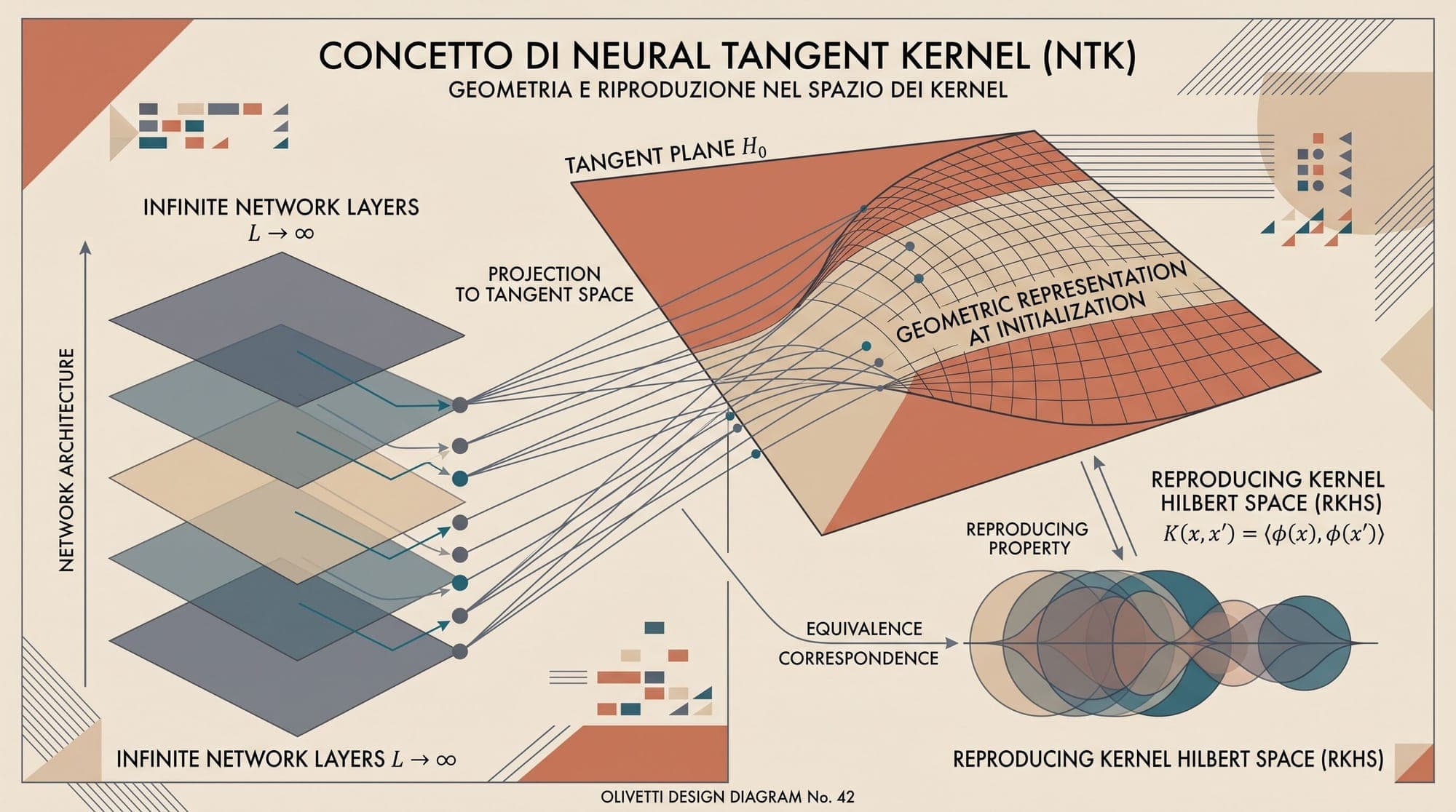
The Neural Tangent Kernel (NTK) describes the behavior of infinitely wide neural networks during gradient descent. In the infinite-width limit, network training reduces to kernel regression with a fixed kernel — the NTK — that stays constant throughout training. This theoretical framework explains why wide networks converge to global minima, why they struggle to learn high-frequency functions early (spectral bias), and why they behave differently from finite-width networks that learn features.
From Finite to Infinite Width
A finite neural network with parameters computes a function . Under gradient flow on loss , the output evolves as:
where $\Theta_t(x, x') = \nabla_\theta f(x; \theta_t)^\top \nabla_\theta f(x'; \theta_t)$ is the empirical NTK at time .
Jacot, Gabriel, and Hongler (2018) showed that as width , two things happen simultaneously [^1]:
- Initialization convergence: deterministically.
- Training constancy: for all .
The network output then follows a linear ODE with a fixed kernel, solvable in closed form:
At , this converges to the kernel ridgeless regression solution — the minimum-norm interpolant in the RKHS of .

Lazy Training vs Feature Learning
The NTK regime is often called lazy training because parameters barely move from initialization: . The network operates as a linear model over fixed random features .
This contrasts with feature learning in finite-width networks, where hidden representations adapt to the task. In the NTK limit, the representation is frozen at initialization — the network cannot discover new features, only recombine the initial random projection.
Practical consequence: If you scale learning rate as (standard parametrization), you enter the NTK regime. The network fits a kernel model but fails to learn hierarchical features. This is why standard parametrization requires careful width scaling to maintain feature learning [^2].
Spectral Bias and Frequency Learning
The NTK's eigen-decomposition on the data distribution reveals spectral bias: the kernel's eigenfunctions correspond to functions of different frequencies, with eigenvalues decaying for higher frequencies. Training fits low-frequency components first; high-frequency components require exponentially more time [^3].
This matches empirical observations:
- Wide networks learn low-frequency patterns quickly but struggle with sharp boundaries and fine details early in training.
- The NTK of ReLU networks has polynomial eigenvalue decay, so high-frequency learning is slow but not impossible.
- Architectural choices (depth, activation, normalization) reshape the NTK spectrum.
NTK and Architecture Design
Depth and Residual Connections
Deeper networks in the NTK limit can suffer from kernel depth degradation: the NTK becomes degenerate, losing expressivity. Residual connections (ResNet) preserve the NTK's conditioning by maintaining signal propagation — the skip connections keep the kernel well-behaved as depth increases [^4].
Normalization
Batch normalization and layer normalization break NTK constancy. They introduce data-dependent scaling that evolves during training, pushing the network out of the lazy regime and enabling feature learning even at large width [^5].
Attention and Transformers
The NTK of attention mechanisms has been characterized: self-attention at initialization yields a kernel that depends on token positions and values. However, transformer NTKs exhibit different spectral properties than MLPs, with implications for long-context extrapolation [^6].
Maximal Update Parametrization (μP)
The NTK limitation — frozen features — led to μP (Maximal Update Parametrization) [^7]. By scaling initialization and learning rates differently (weights , learning rate constant, output scaled by ), μP enables feature learning in the infinite-width limit. The network no longer linearizes; hidden representations evolve, and the limiting object is a tensor program rather than a fixed kernel.
μP is now standard for large language model pre-training (GPT-3, PaLM, LLaMA families use μP-compatible scaling). It allows hyperparameter transfer: optimal learning rates found on small μP models transfer directly to large ones.
NTK-Aware Positional Encoding (RoPE Scaling)
The NTK's spectral bias insight was applied to rotary position embeddings (RoPE). Standard RoPE interpolation stretches all frequencies uniformly, degrading high-frequency precision. NTK-Aware RoPE scaling (bloc97, 2023) applies non-linear frequency scaling derived from NTK theory: low frequencies interpolate more aggressively, high frequencies are preserved [^8]. This formed the basis for YaRN and LongRoPE context extension methods.
Limitations of the NTK Framework
| Aspect | NTK Prediction | Reality in Finite Networks | |--------|----------------|----------------------------| | Feature learning | None (frozen at init) | Core to deep learning success | | Generalization | Kernel RKHS norm | Implicit regularization, flat minima | | Scaling laws | Power-law with width | More complex, includes feature learning | | Transfer learning | Kernel alignment | Representation adaptation |
The NTK is a first-order approximation valid only in the infinite-width limit with standard parametrization. It does not capture:
- Representation learning and hierarchical feature formation
- The role of optimization trajectory in generalization
- Emergence of circuit-level mechanisms (induction heads, etc.)
- Phase transitions during training
Summary
The Neural Tangent Kernel provides a mathematically exact description of gradient descent in infinitely wide networks. It explains convergence, spectral bias, and the lazy training regime — and its limitations motivated μP and modern scaling practices. For practitioners, the key takeaway: if your network behaves like an NTK model, it is not learning features. Architectural choices (residuals, normalization, μP) exist precisely to escape this regime.
Sources
[^1]: Jacot, A., Gabriel, F., & Hongler, C. (2018). Neural Tangent Kernel: Convergence and Generalization in Neural Networks. NeurIPS 2018. https://arxiv.org/abs/1806.07572 [^2]: Yang, G., & Hu, E. J. (2021). Tensor Programs IV: Feature Learning in Infinite-Width Neural Networks. ICML 2021. https://arxiv.org/abs/2011.14522 [^3]: Rahaman, N., et al. (2019). On the Spectral Bias of Neural Networks. ICML 2019. https://arxiv.org/abs/1806.08734 [^4]: Lee, J., et al. (2020). Finite versus Infinite Neural Networks: an Empirical Study. NeurIPS 2020. https://arxiv.org/abs/2007.15807 [^5]: Yang, G., et al. (2022). Tensor Programs V: Tuning Large Neural Networks via Zero-Shot Hyperparameter Transfer. ICLR 2023. https://arxiv.org/abs/2203.03466 [^6]: Hron, J., et al. (2020). Infinite Attention: NNGP and NTK for Deep Attention Networks. ICML 2020. https://arxiv.org/abs/2006.10550 [^7]: Yang, G., et al. (2022). Maximal Update Parametrization (μP). https://arxiv.org/abs/2203.03466 [^8]: bloc97 (2023). NTK-Aware Scaled RoPE. https://github.com/bloc97/NTK-aware-scaled-RoPE