Microsoft is pushing its newly generally available Fireworks AI integration at startups, publishing a deployment blueprint on August 4, 2026 that pairs a reference architecture for running open models on Microsoft Foundry with a financial incentive: members of the Microsoft for Startups program can apply Azure credits to Fireworks deployments, with the program advertising up to $150,000 in credits.
The Fireworks integration reached general availability, placing open-weight models from DeepSeek, Moonshot AI, Z.ai, MiniMax, Qwen, Google, and OpenAI's gpt-oss line inside Azure's model catalog with Azure-side governance and billing. Fireworks AI runs inference behind the catalog; Foundry supplies the control plane.
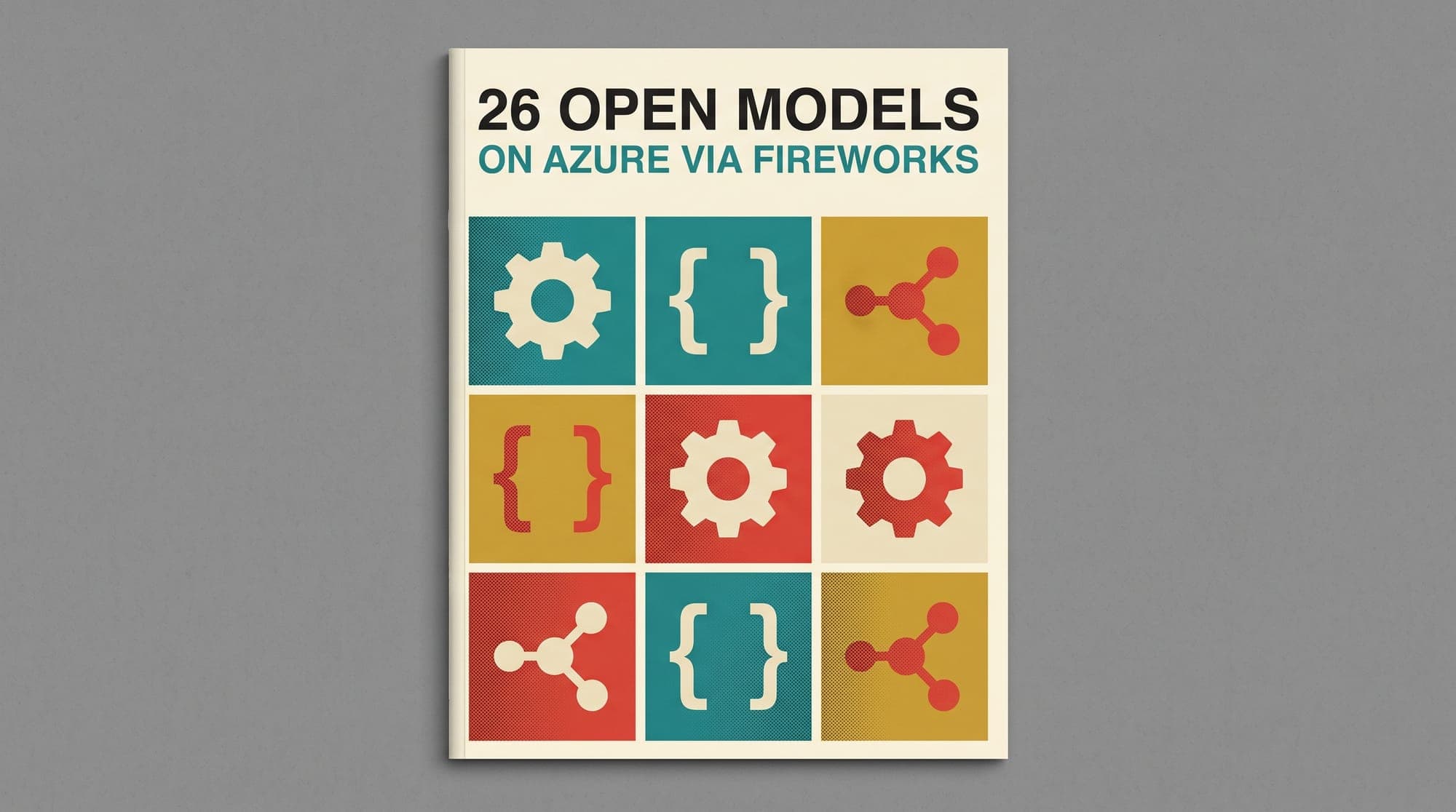
The Foundry catalog now lists 26 Fireworks-served models, including Moonshot AI's Kimi K2.5, DeepSeek V3.2, MiniMax M2.5, OpenAI's gpt-oss-120b, and a DeepSeek V4 Pro described as a 1.6-trillion-parameter flagship. Six of them, including Kimi K2.6 and Z.ai's GLM-5.1, are available on pay-per-token serverless billing; the rest run on provisioned throughput units, Azure's reserved-capacity pricing.

What startups build
The reference architecture runs entirely inside a startup's own Azure subscription: a containerized app on Azure Container Apps calls a Fireworks endpoint deployed through Foundry, with Azure Key Vault holding credentials and Azure Monitor tracking latency, error rate, and token consumption. Teams can add Redis caching and API management as traffic grows, and import custom or fine-tuned weights through a bring-your-own-weights workflow with LoRA adapter support in public preview.
The fine print
The credit terms carry real limits. Credits apply only to pay-per-token Data Zone Standard usage, and provisioned throughput units are excluded. Serverless deployments are confined to six US Azure regions, sit outside Microsoft's EU Data Boundary, carry no FedRAMP authorization, and cannot touch payment-card data. Microsoft also states it does not evaluate the safety or behavior of Fireworks-served models, leaving that assessment to the customer.
One dated item: pay-per-token billing for GLM-5.1 and MiniMax M2.5 is deprecated effective August 7, 2026, though both remain available on provisioned throughput, and pay-per-token offerings for four other catalog models are already deprecated.
The move extends a longer multi-vendor catalog strategy. Microsoft widened its Mistral arrangement in July 2026 to court regulated buyers and has been shifting some Office AI workloads across model providers to manage costs. Outsourcing the inference layer to a specialist rather than building it in-house keeps Foundry's role as the control plane while widening the open-model selection.
Sources
Microsoft Opens 26 Open Models to Startups Through Fireworks AI on Foundry - Unite.AI: https://www.unite.ai/microsoft-opens-26-open-models-to-startups-through-fireworks-ai-on-foundry/
How to deploy Fireworks AI on Microsoft Foundry (startup blueprint), Aug 4 2026: https://www.microsoft.com/en-us/startups/blog/how-to-deploy-fireworks-ai-on-microsoft-foundry-a-startup-architecture-blueprint/