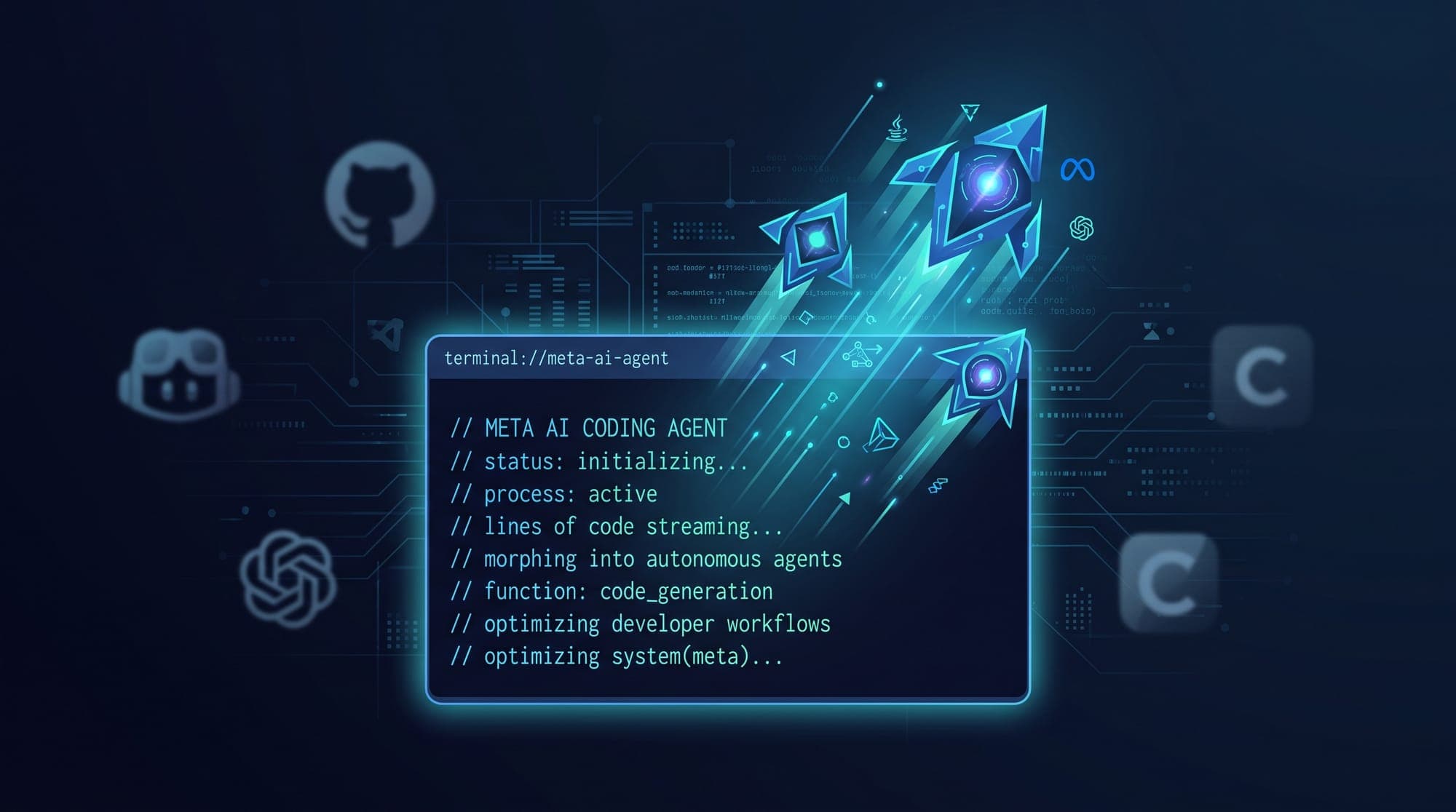
Meta has launched Muse Code, a terminal-based AI coding agent now in beta, alongside Muse Spark 1.2, a coding-focused update to its proprietary frontier model family. The two releases put Meta in direct competition with Anthropic's Claude Code, OpenAI's Codex, and the growing field of agentic coding tools that have become the default way many developers ship software.
Muse Code is installable on macOS or Linux with a single curl command, though it requires a Meta account and billing details. Unlike some rival tools that are free during beta, Meta is charging from day one.
The agent's headline architectural choice is persistent async background agents. Rather than spawning helper sub-agents fresh for each task -- the pattern used by most competing harnesses -- Muse Code keeps specialized background agents alive for the entire session. Meta says this avoids redundant repository exploration and reduces the need for developer intervention on multi-step tasks.
When a job is large enough, Muse Code fans out to parallel sub-agents, each operating in its own isolated git worktree. "In testing we had it build six features for a game simultaneously with no collisions," Meta CEO Mark Zuckerberg wrote in a post on X.

A second notable design choice is a local event log that records every model call, tool run, approval, and edit before execution. Meta describes the log as a single source of truth that makes the runtime "replay-exact and restart-safe." If Muse Code crashes mid-task, it resumes precisely where it stopped without lost work or re-prompting.
The harness ships with bundled commands familiar to users of rival tools: /plan turns a task into an approval-gated plan, /grill stress-tests that plan, and /goal drives the agent toward completion.
The model underneath
Under the hood is Muse Spark 1.2, which Meta describes as a coding-focused update with significantly scaled-up training compute on coding tasks and broader environment diversity. The original Muse Spark, launched in April, scored 77.4 on SWE-Bench Verified, trailing Claude Opus 4.6's 80.8 and Gemini 3.1 Pro's 80.6. Meta did not headline specific benchmark scores for version 1.2, instead directing readers to a separate methodology report.
Two training details stand out. First, Meta co-trained the model with Muse Code itself, using rejection-sampled harness trajectories so the model is explicitly tuned to perform best inside this particular tool. That mirrors an industry shift away from treating models and harnesses as separable products. Second, Meta used a self-improvement loop: Muse Spark 1.1 generated challenging coding environments and graded candidate solutions, producing a scalable training dataset for its successor.
Meta published a case study showing Muse Spark 1.2 iteratively optimizing GPU kernels over more than 1,000 tool calls across up to 24 hours, achieving substantial speedups against baseline Triton implementations of KDA and MLA attention kernels on NVIDIA Hopper GPUs.
Why it matters
The launch marks Meta's most serious move yet into a category it has largely watched from the sidelines. While Anthropic and OpenAI turned coding agents into flagship products, Meta's developer story previously centered on Llama, the open-weight model family that has seen more than a billion downloads. Muse Code is entirely proprietary. The co-training approach -- tuning a model specifically for its harness rather than treating the two as independent products -- is becoming the industry standard, but Meta's entry raises the competitive stakes in a market where developer tooling increasingly determines model adoption.
Sources
Introducing Muse Code and Muse Spark 1.2 - Meta AI Research, August 5, 2026: https://research.meta.ai/blog/introducing-muse-code-and-muse-spark-1-2
Meta enters the AI coding wars with Muse Spark 1.2 and Muse Code with persistent async background agents - VentureBeat, August 5, 2026: https://venturebeat.com/orchestration/meta-enters-the-ai-coding-wars-with-muse-spark-1-2-and-muse-code-with-persistent-async-background-agents