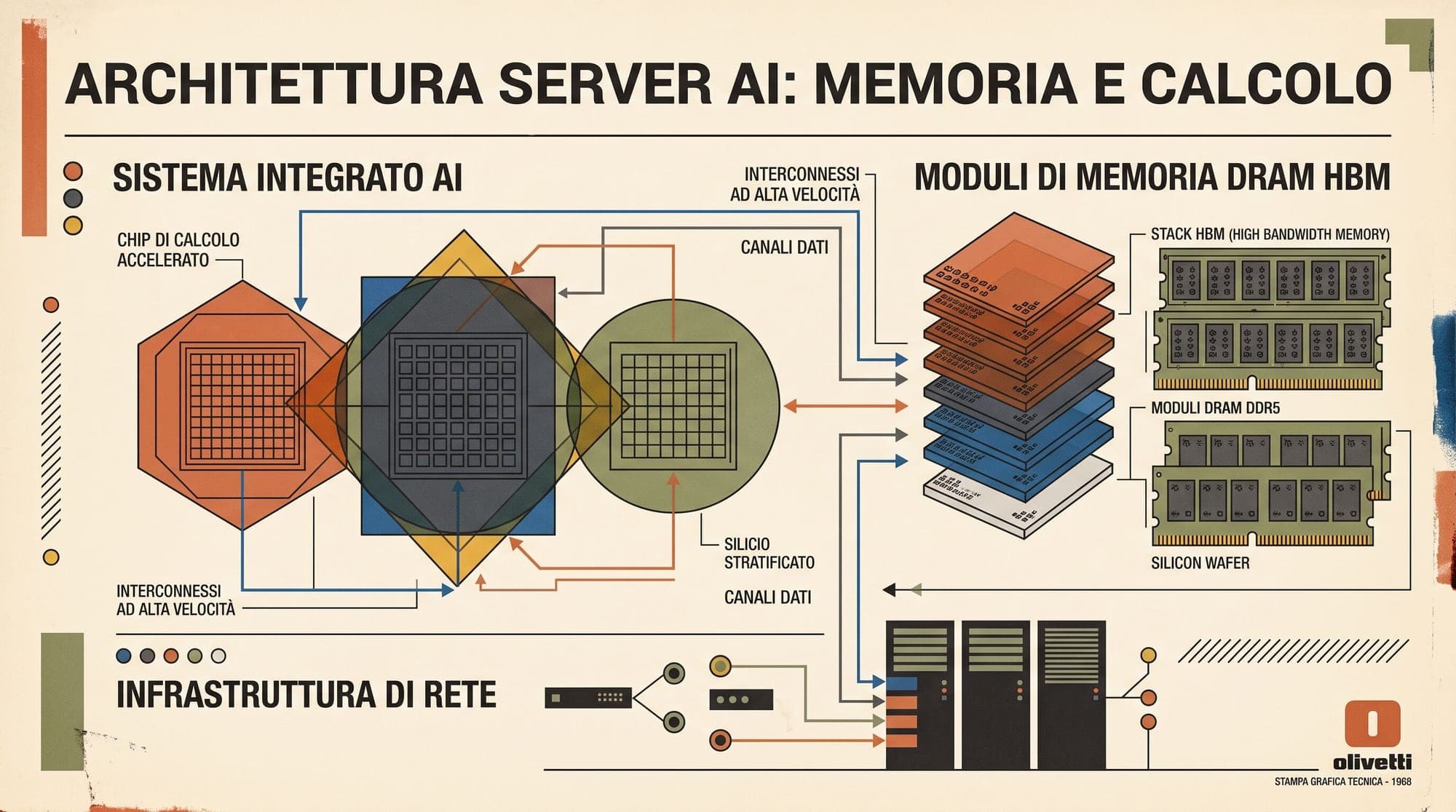
Nvidia has notified major customers that prices for server systems containing its artificial intelligence accelerators are increasing by more than 15% in many configurations, according to reports from Bloomberg and Fortune. The price adjustments stem from severe supply constraints and rising costs across dynamic random-access memory (DRAM) and high-bandwidth memory (HBM) modules.
The price increases will apply to server systems scheduled for delivery starting in early 2027, covering platforms powered by Nvidia's current Grace Blackwell architecture as well as its upcoming Vera Rubin hardware. Contract manufacturers assembling AI hardware for major cloud providers, including Microsoft, Google, and Oracle, have begun notifying enterprise clients of the updated pricing terms.

Memory Bottlenecks and Component Pricing
The primary driver behind the server-level price increases is escalating procurement costs for memory components supplied by Samsung Electronics, SK Hynix, and Micron Technology. As frontier AI models demand larger parameter counts and wider context windows, the ratio of memory capacity and bandwidth required per GPU accelerator has surged.
Nvidia's Vera Rubin platform pairs the Rubin GPU with up to 288GB of HBM4 memory alongside the 88-core Vera CPU, placing intense demand on advanced memory packaging lines. The tight supply of HBM and high-density server DRAM has strengthened the pricing power of the three primary memory vendors, leaving system assemblers and Nvidia unable to absorb the cost differentials.
Supply chain reports from TrendForce indicate that memory tightness is already influencing Nvidia's product roadmaps. Nvidia is reportedly evaluating diversified memory configurations for its upcoming Rubin Ultra accelerators, including eight-stack HBM4E and standard HBM4 options alongside planned twelve-stack designs, to hedge against potential memory shortages persisting through 2027.
Capital Expenditure Pressures on Hyperscalers
The price adjustments will directly impact the capital expenditure budgets of the largest AI infrastructure operators, including Microsoft, Amazon Web Services, Alphabet, Meta, OpenAI, and Anthropic. While several hyperscalers continue to develop in-house custom silicon, such as Google's TPUs and Amazon's Trainium chips, frontier training and low-latency inference workloads remain heavily anchored to Nvidia hardware.
The price increases highlight the structural feedback loop in AI hardware financing. The same cloud operators investing tens of billions of dollars into data center buildouts are funding the market position and pricing power of upstream component suppliers. As data center power, cooling, and memory costs escalate simultaneously, infrastructure operators face mounting pressure to demonstrate tangible software revenues capable of supporting sustained hardware investments.