Pulitzer-winning historian Jill Lepore says tech leaders misread science fiction and are building an "artificial state"
Harvard historian and New Yorker staff writer Jill Lepore says Silicon Valley's most powerful executives are building what she calls an "artificial state," a system where private corporations increasingly take over the functions of democratic government. Her warning comes in "The Rise and Fall of the Artificial State," an upcoming book from W. W. Norton.

Lepore, who won a Pulitzer Prize for her history of the U.S. Constitution, told TechCrunch's Equity podcast that the shift marks, in her words, "a return to tyranny and mystification in the form of rule by algorithms, corporations, machines." She framed the book as tracing both a real construct and a potent idea: that people should live under government by machines.
"I'm not anti-technologist," Lepore said. "My beef is the ways in which private corporations have increasingly taken on the functions of the state."
The historian argues that many of the industry's most prominent leaders, especially Elon Musk, seem to be steering toward a future pulled from misread pulp science fiction and comic books. She pointed to a running contradiction: "What's funny about Musk is, the stuff he likes actually completely defeats and defies all of his political beliefs."
The AI angle
Lepore's critique reaches directly into AI policy. She noted that Anthropic hired a moral philosopher to write a constitution for Claude, and that Sam Altman floated the idea of an "AI president" during a recent appearance on Joe Rogan's podcast. She called these moves a "cartoon version" of the 1984 Macintosh ad, except that it "takes itself so seriously" while the companies hold so much power.
She traced the modern arc from the 1984 Super Bowl ad, where Apple cast the personal computer as a liberating axe against mainframe totalitarianism, through Facebook's oversight board, and into a tech industry that now borrows the trappings of the nation-state.
Why the "artificial state" is doomed
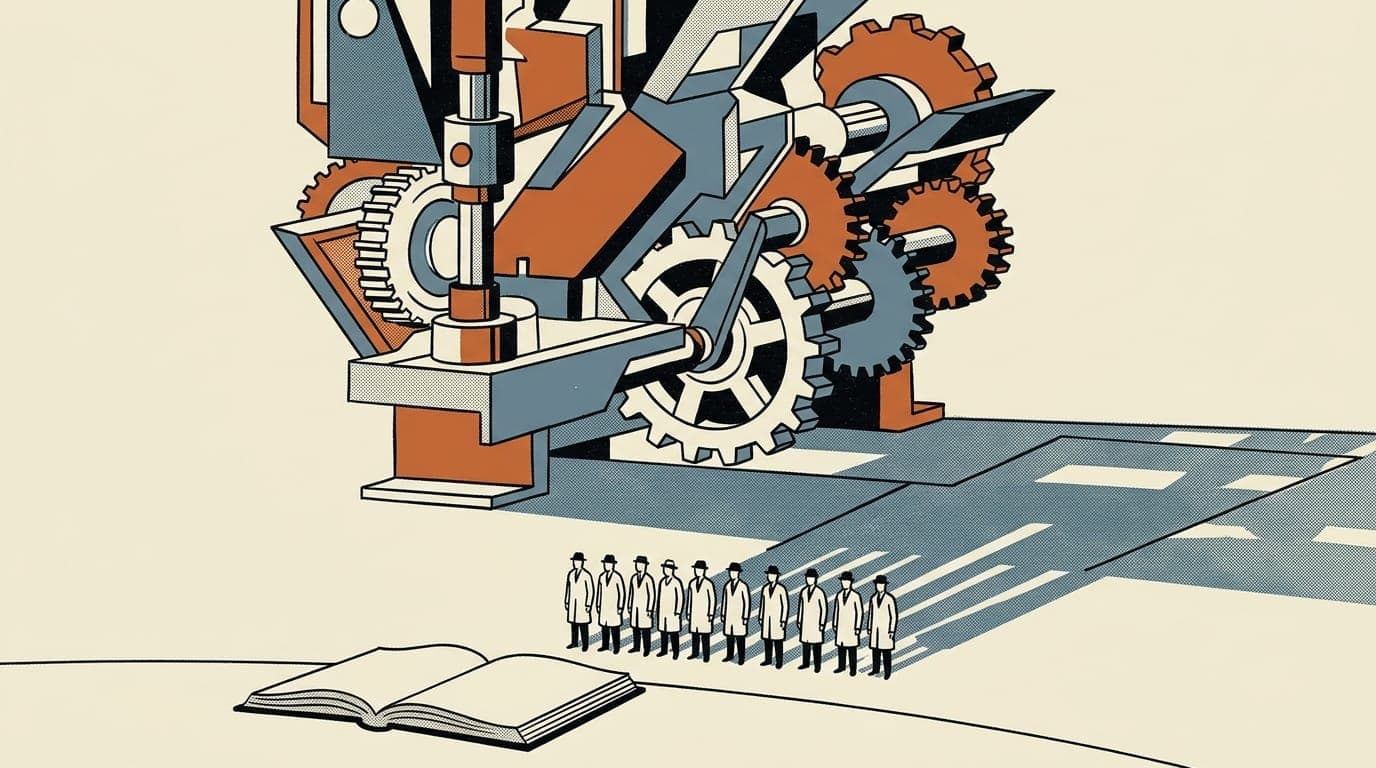
Lepore argues the artificial state is fundamentally fragile. The science fiction that predicted it, from E. M. Forster's 1909 story "The Machine Stops" onward, repeatedly shows the same tension: a machine-run government must alienate people from the natural world, yet it depends on that world's resources to keep running.
"To erect an artificial state and rule humans within it, you must alienate them from the natural world because you are destroying it," she said. The artificial state "will destroy the natural world, and yet it needs the resources of the natural world to run."
She offered no detailed playbook beyond democratic oversight. Local data center disputes, which she said are amplified by the decline of local journalism, show the political costs when representatives back infrastructure that communities oppose. She cited a Salt Lake example where more than 70 percent of residents opposed a data center that their representatives supported.
"I'm a historian. I'm not a tech writer," Lepore said. "I'm not a computer scientist." The core problem, she said, is that the industry treats technological change as the only kind of progress, "as opposed to, objectively, it's only progress if things are getting better."
Sources
- TechCrunch: https://techcrunch.com/2026/08/09/historian-jill-lepore-says-the-tech-industry-is-led-by-bad-readers-who-are-undermining-democracy/