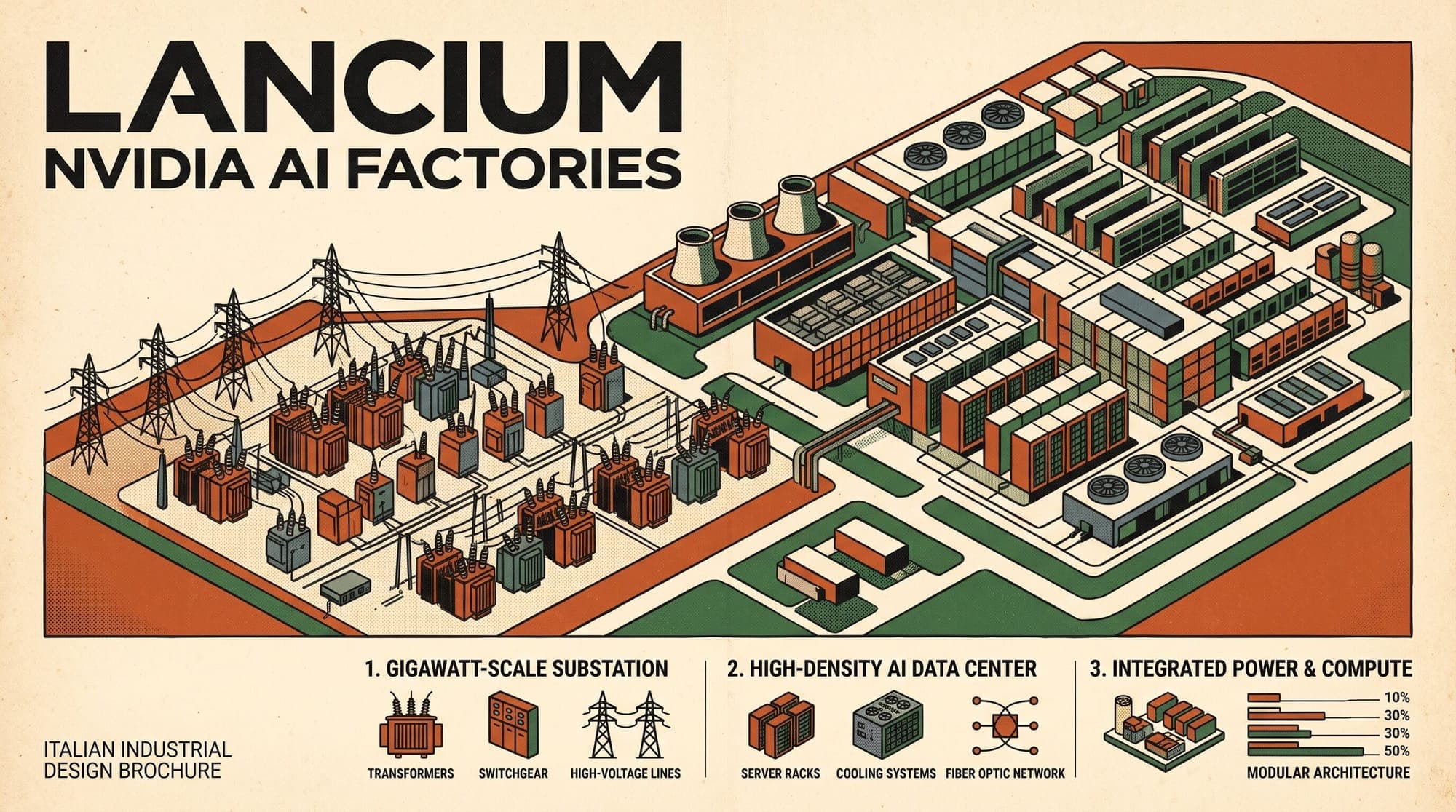
Texas energy infrastructure provider Lancium has entered a strategic partnership with NVIDIA to deploy NVIDIA's full AI factory technology stack across Lancium's multi-gigawatt clean energy data center portfolio. As part of the transaction, NVIDIA has taken a direct equity stake in Lancium, which is backed by funds managed by Blackstone Energy Transition Partners and Blackstone Multi-Asset Investing.
The partnership combines Lancium's 4 gigawatts of operational and leased capacity and a pipeline exceeding 15 gigawatts of powered land with NVIDIA's accelerated computing, networking, and data center reference architecture.

DSX Platform Integration
Lancium campuses will standardize on NVIDIA's DSX AI factory platform, incorporating two primary hardware and power-management frameworks:
- DSX MaxLPS: A suite of power management and thermal optimization technologies combining 45°C warm-water liquid cooling with dynamic in-rack frequency controls. NVIDIA reports that the architecture allows facility operators to host up to 40% more GPUs within a fixed electrical interconnection limit by maintaining accelerators at their most energy-efficient performance envelope.
- DSX Flex: An intelligent power orchestration layer designed to interface directly with regional grid operators such as ERCOT. The system dynamically modulates compute power draw in response to real-time grid signals, including demand response events, pricing spikes, and automated load shedding, while balancing behind-the-meter solar and battery storage.
Portfolio and Buildout Timeline
Lancium's portfolio centers on large-scale campuses engineered for high-density compute:
- Abilene, Texas: A 1.2 GW flagship campus currently energizing facilities to serve as the initial operational deployment site for the Stargate compute cluster.
- Childress, Texas: A 1.0 GW campus announced in partnership with Crusoe, scheduled to begin physical construction in the third quarter of 2026.
- Development Pipeline: Over 15 GW of powered land assets across Texas, supported by a $600 million credit facility secured in late 2025.
Lancium retains ownership of the underlying real estate and substation energy infrastructure, partnering with specialized operators such as Crusoe to construct and manage the white-space facilities.
Upstream Infrastructure Capital
The equity investment reflects NVIDIA's broader strategy of securing long-lead power and physical data center capacity to ensure delivery timelines for its accelerated compute systems. The transaction follows NVIDIA's recent minority investment in power and land developer Cloverleaf Infrastructure, alongside capital partnerships with institutional asset managers including Apollo, BlackRock, Blackstone, Brookfield, Goldman Sachs, and KKR designed to deploy over $500 billion into AI infrastructure.