Higgsfield AI Raises $400M at $5.4B Valuation, Quadrupling in Seven Months

Higgsfield AI Raises $400M at $5.4B Valuation, Quadrupling in Seven Months AI video generation startup Higgsfield has raised $400 million in a Series B round that values the company at $5.4 billion, up from $1.3 billion in January. The round was led by DST Global with participation from Goldman Sachs, Liberty Global, Intel Capital, and others. The 4x valuation jump in seven months signals intense investor appetite for the AI video layer that could become the foundation for robotics, world mod

1 min
Higgsfield AI Raises $400M at $5.4B Valuation, Quadrupling in Seven Months

Higgsfield AI Raises $400M at $5.4B Valuation, Quadrupling in Seven Months

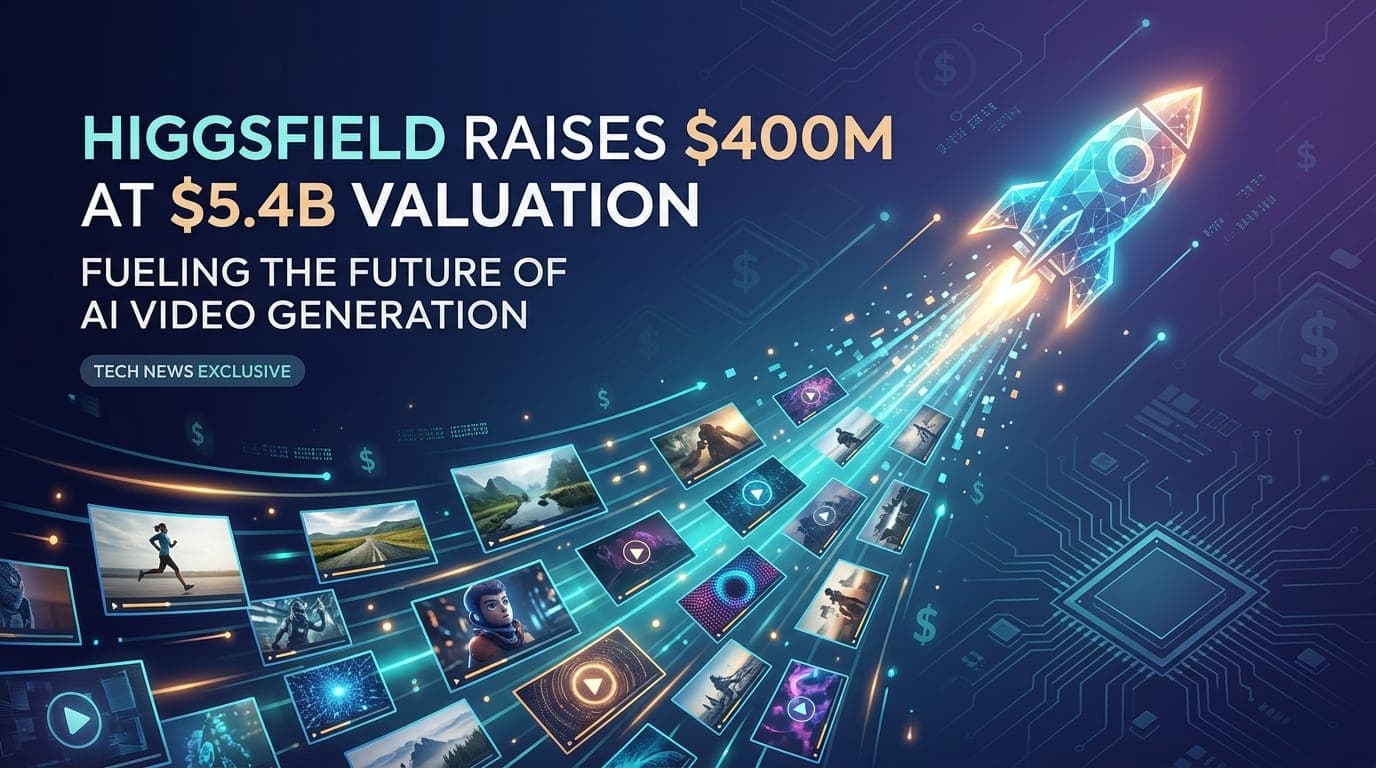
Infographic showing Higgsfield's competitive position in AI video generation

AI video generation startup Higgsfield has raised $400 million in a Series B round that values the company at $5.4 billion, up from $1.3 billion in January.

The round was led by DST Global with participation from Goldman Sachs, Liberty Global, Intel Capital, and others.

The 4x valuation jump in seven months signals intense investor appetite for the AI video layer that could become the foundation for robotics, world models, and content creation.

What Higgsfield Does

Higgsfield builds video generation models and the infrastructure to run them at scale. Its flagship model targets cinematic-quality video with consistent character identity, camera control, and physics-aware motion.

The company was founded by Alex Mashrabov, who previously led AI at Snap. The team includes researchers from Google DeepMind, Meta, and NVIDIA.

Why Video Generation Matters

AI video models learn motion, causality, and physics — the building blocks of a world model for robots and self-driving cars.

The Competitive Landscape

Google's Veo 2 leads on quality but remains closed. Runway Gen-3 Alpha focuses on short-form. MiniMax Hailuo scores highly on human eval. Chinese labs hold 9 of the top 10 spots.

The Money and What It Buys

$400 million at $5.4B post-money funds compute, serving infrastructure, go-to-market for robotics customers, and IP licensing.

Bottom Line

Higgsfield's raise bets that the video generation layer becomes as foundational as LLMs. At $5.4B, investors are pricing in category leadership.

Sources

Financial Times, Techmeme, The Decoder

Written by

More to read

  • Continuous Pre-Training in Production: Domain Adaptation, Replay Buffers, Learning Rate Restarts, and Catastrophic Forgetting Mitigation

    Continuous Pre-Training in Production: Domain Adaptation, Replay Buffers, Learning Rate Restarts, and Catastrophic Forgetting Mitigation Adapting general-purpose foundation models to specialized enterprise domains (such as clinical medicine, corporate law, quantitative finance, and proprietary software codebases) presents a fundamental architectural challenge. While Retrieval-Augmented Generation (RAG) and Supervised Fine-Tuning (SFT) remain standard first-line approaches, both exhibit severe s

    1 min
  • Hybrid SSM-Transformer Architectures: How Interleaving Attention and Recurrence Solves the State-Retrieval Trade-Off

    Hybrid SSM-Transformer Architectures: How Interleaving Attention and Recurrence Solves the State-Retrieval Trade-Off Autoregressive language models face a fundamental tension between inference efficiency and long-context retrieval capacity. Pure Transformer architectures scale quadratic computational complexity during sequence prefill and linear key-value (KV) cache memory consumption during autoregressive token generation. Conversely, pure State Space Models (SSMs) and linear recurrent neural

    1 min
  • Study: Why Labor-Saving LLMs Incline Scientists to Do More Work Less Well

    A theoretical study published by researchers from Princeton University, the University of Washington, and collaborating institutions models how large language models alter researchers' time allocation across projects. The authors find that by reducing time friction across different stages of the research lifecycle, AI assistants increase the opportunity cost of researcher time, creating economic incentives to publish a higher volume of less thoroughly refined papers. The paper, titled The unint

    1 min