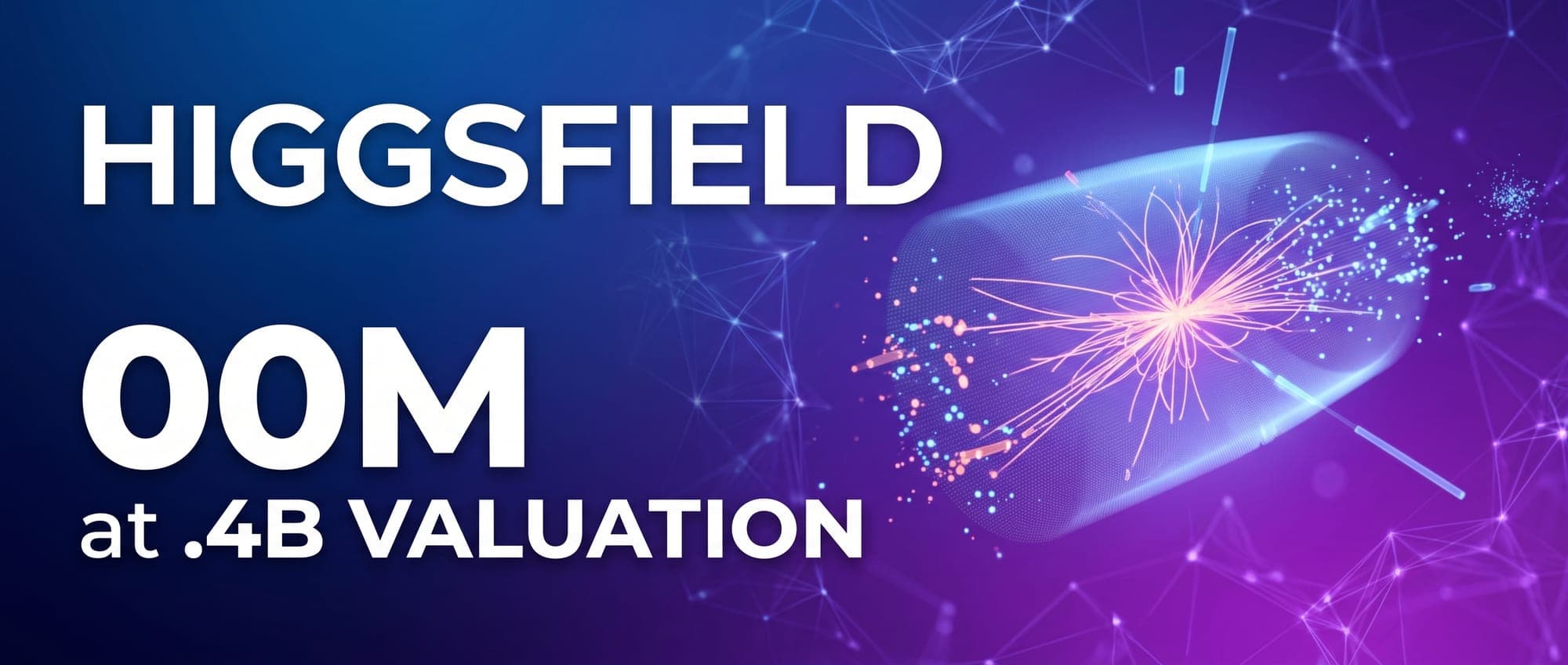
AI video generation startup Higgsfield has raised $400 million in a Series B round that values the company at $5.4 billion, up from $1.3 billion in January. The round was led by DST Global with participation from Goldman Sachs, Liberty Global, Intel Capital, and others.
The 4x valuation jump in seven months signals intense investor appetite for the AI video layer that could become the foundation for robotics, world models, and the next generation of content creation.
What Higgsfield Does
Higgsfield builds video generation models and the infrastructure to run them at scale. Its flagship model, Higgsfield 1, targets cinematic-quality video with consistent character identity, camera control, and physics-aware motion, capabilities that go beyond the short, prompt-driven clips that dominate today's AI video landscape.
The company was founded by Alex Mashrabov, who previously led AI at Snap (including the team behind Snapchat's AR lenses and generative AI features). The team includes researchers from Google DeepMind, Meta, and NVIDIA.
Why Video Generation Matters Beyond Content

AI video is not just about making clips. Video models learn motion, causality, and physics, the building blocks of a world model for robots and self-driving cars. The leap to true world models is early, and copyright fights are real.
Higgsfield's approach emphasizes controllability: directors can specify camera moves, character consistency across shots, and physical plausibility. That makes it usable for pre-visualization, VFX pipelines, and eventually synthetic training data for robotics.
The Competitive Landscape
Higgsfield differentiates on the infrastructure layer: a full stack from model to serving, with APIs and tools built for production workflows rather than consumer play.
The Money and What It Buys
$400 million at $5.4B post-money means approximately 7.4% dilution. The capital funds:
Investor Rationale
DST Global (Yuri Milner) has a track record of backing infrastructure-layer AI (Anthropic, OpenAI secondary). Goldman Sachs and Intel Capital signal strategic interest: Goldman for the fintech/AI intersection, Intel for the silicon roadmap (Gaudi/Habana alignment). Liberty Global brings distribution via European telecom and media assets.
Risks
Bottom Line
Higgsfield's raise is a bet that the video generation layer becomes as foundational as LLMs, and that the winner owns the full stack from model to production pipeline. At $5.4B, investors are pricing in category leadership, not just a feature.
Sources
Financial Times: James Fontanella-Khan, "AI video generation startup Higgsfield raised $400M from DST, Goldman Sachs, Liberty Global, Intel, and others at a $5.4B valuation, up from $1.3B in January" (Aug 17, 2026)
Techmeme: Snapshot 260817/p3
The Decoder: "China's AI Labs Dominate Text-to-Video" (Aug 14, 2026) - context on competitive landscape