Google Launches Gemini Student Hub with Interactive 3D Simulations and Background Research

Google has launched a dedicated suite of education tools across Google Search and the Gemini assistant, introducing an integrated student hub, interactive 3D simulations, multi-document synthesis, and asynchronous background research. The rollout is designed to centralize study workflows within Google's ecosystem while expanding the modal capabilities of Gemini for scientific and conceptual analysis. Integrated Student Hub and Study Notebooks The core of the update is a specialized hub withi

2 min
Google Launches Gemini Student Hub with Interactive 3D Simulations and Background Research

Google has launched a dedicated suite of education tools across Google Search and the Gemini assistant, introducing an integrated student hub, interactive 3D simulations, multi-document synthesis, and asynchronous background research.

The rollout is designed to centralize study workflows within Google's ecosystem while expanding the modal capabilities of Gemini for scientific and conceptual analysis.

Integrated Student Hub and Study Notebooks

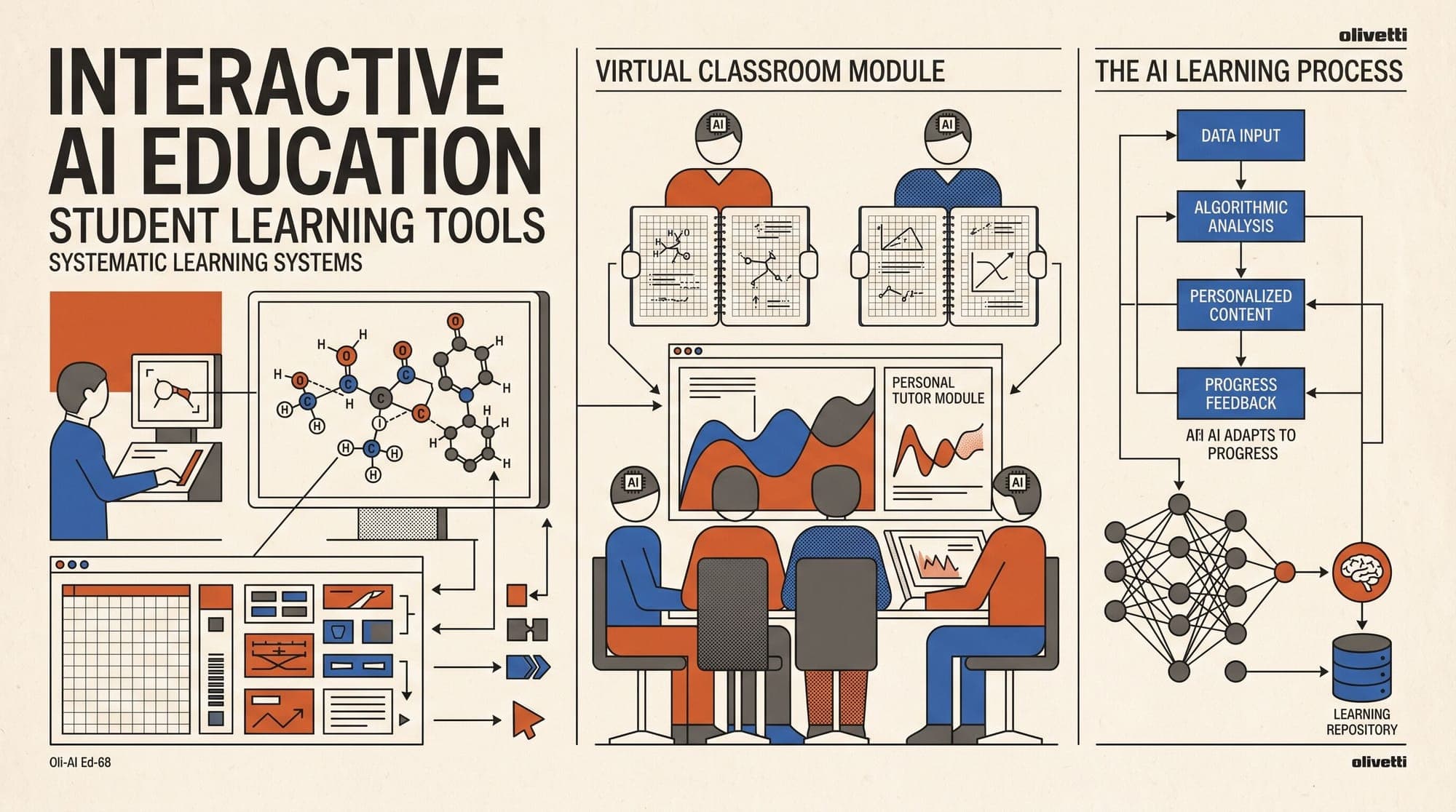
The core of the update is a specialized hub within the Gemini application. The interface consolidates study notebooks, automated flashcards, and custom practice quizzes. Students can also upload course syllabi, which Gemini parses to automatically populate test dates and assignment deadlines into Google Calendar.

Alongside text-based summaries, Gemini can now generate functional, interactively rotatable 3D simulations directly in chat responses. For visual learning topics in biology, physics, and chemistry, such as DNA molecular structures or atomic lattices, users can manipulate models in three dimensions alongside structured data tables and conceptual grids.

Technical diagram illustrating automated background research synthesis and interactive educational study cards

Multi-File Synthesis and Background Deep Research

Google Search has also been updated to process multi-format document uploads. Users can submit lecture slides, textbook PDFs, and photographs of handwritten class notes simultaneously. Search analyzes the combined corpus to generate consolidated study documents and one-page topic summaries.

For complex academic inquiries, Google integrated Deep Research into Gemini Live. Users can prompt Gemini to run multi-step investigatory reports across web sources. The process runs asynchronously, allowing users to close the application or lock their device. Gemini notifies the user upon completion, enabling conversational review of findings via voice or text.

Visual Problem-Solving via Lens and Subscription Tiers

In the coming weeks, Google will roll out an interactive learning update to Google Lens in the mobile app. The tool allows students to photograph physical worksheets or handwritten math problems. Rather than returning raw answers, the system identifies calculation errors, provides conceptual explanations, and guides students step-by-step through problem remediation.

To drive adoption, Google is offering eligible higher education students in the United States one free year of Google AI Pro, which includes 5TB of cloud storage, elevated Gemini usage thresholds, and integration across Google Workspace. International students will have access to the Google AI Plus plan, which includes 400GB of storage and standard Gemini access limits.

Sources

Written by

More to read

  • Auxiliary-Loss-Free Load Balancing in Mixture-of-Experts: How Dynamic Bias Adjustments Eliminate Gradient Conflict and Routing Collapse

    Sparse Mixture-of-Experts (MoE) architectures decouple parameter count from per-token compute cost by activating only a small subset of feed-forward network (FFN) parameters for any given token. While dense transformers evaluate every parameter across all sequence positions, MoE models route tokens dynamically to specialized sub-networks, enabling parameter scaling to hundreds of billions or trillions of parameters at the inference and training cost of much smaller dense models. However, condit

    1 min
  • Confidential LLM Inference in Production: Hardware TEEs, GPU Enclaves, Attestation, and Serving Performance Trade-Offs

    Confidential LLM Inference in Production: Hardware TEEs, GPU Enclaves, Attestation, and Serving Performance Trade-Offs Deploying large language models in multi-tenant cloud environments introduces a fundamental security boundary problem. Standard transport encryption (TLS) secures prompts in transit, and encryption-at-rest protects checkpoints on disk, but model weights, prompt tokens, and key-value (KV) caches exist in plaintext within system memory during active inference. For organizations p

    1 min
  • Google DeepMind Outlines 15-Year Game AI Arc and EVE Online Research Sandbox

    Google DeepMind has detailed its 15-year trajectory of game-based artificial intelligence research, outlining how milestones from arcade reinforcement learning to modern multimodal models have culminated in an experimental research program inside the persistent virtual universe of EVE Online. The retrospective connects early breakthroughs in discrete, fully observable games to the frontier challenges currently facing autonomous systems: long-horizon planning, non-stationary multi-agent dynamics

    1 min