Google DeepMind has detailed its 15-year trajectory of game-based artificial intelligence research, outlining how milestones from arcade reinforcement learning to modern multimodal models have culminated in an experimental research program inside the persistent virtual universe of EVE Online.
The retrospective connects early breakthroughs in discrete, fully observable games to the frontier challenges currently facing autonomous systems: long-horizon planning, non-stationary multi-agent dynamics, and continual memory across weeks or months.
From Discrete Milestones to Generalist Game Agents
DeepMind's game research began with the Deep Q-Network (DQN) in 2015, which learned to play 49 Atari 2600 titles directly from raw screen pixels without domain-specific engineering. That foundation evolved through a sequence of increasingly complex competitive games:
- AlphaGo (2016) and AlphaGo Zero (2017) demonstrated that deep reinforcement learning combined with Monte Carlo tree search could master Go, with the latter removing human expert demonstration data entirely through pure self-play.
- AlphaZero (2018) and MuZero (2020) unified algorithms across chess, shogi, and Go, with MuZero learning environmental dynamics without access to underlying game rules.
- AlphaStar (2019) reached Grandmaster ranking in StarCraft II, handling real-time imperfect information and vast action spaces.
- AlphaFold, which transferred reinforcement learning and search insights to structural biology, was recognized with the 2024 Nobel Prize in Chemistry.
While those systems optimized for high scores in closed environments with fixed victory conditions, DeepMind shifted its focus toward generalist agents capable of operating across varied virtual worlds using the same visual and control interfaces as human players.

This led to the development of SIMA (Scalable Instructable Multiworld Agent) and its successor SIMA 2, which incorporates Gemini foundation models to interpret natural-language instructions, reason about mid-level objectives, and execute actions via standard mouse and keyboard inputs without direct access to internal game state or APIs.
The Research Frontier in Persistent Worlds
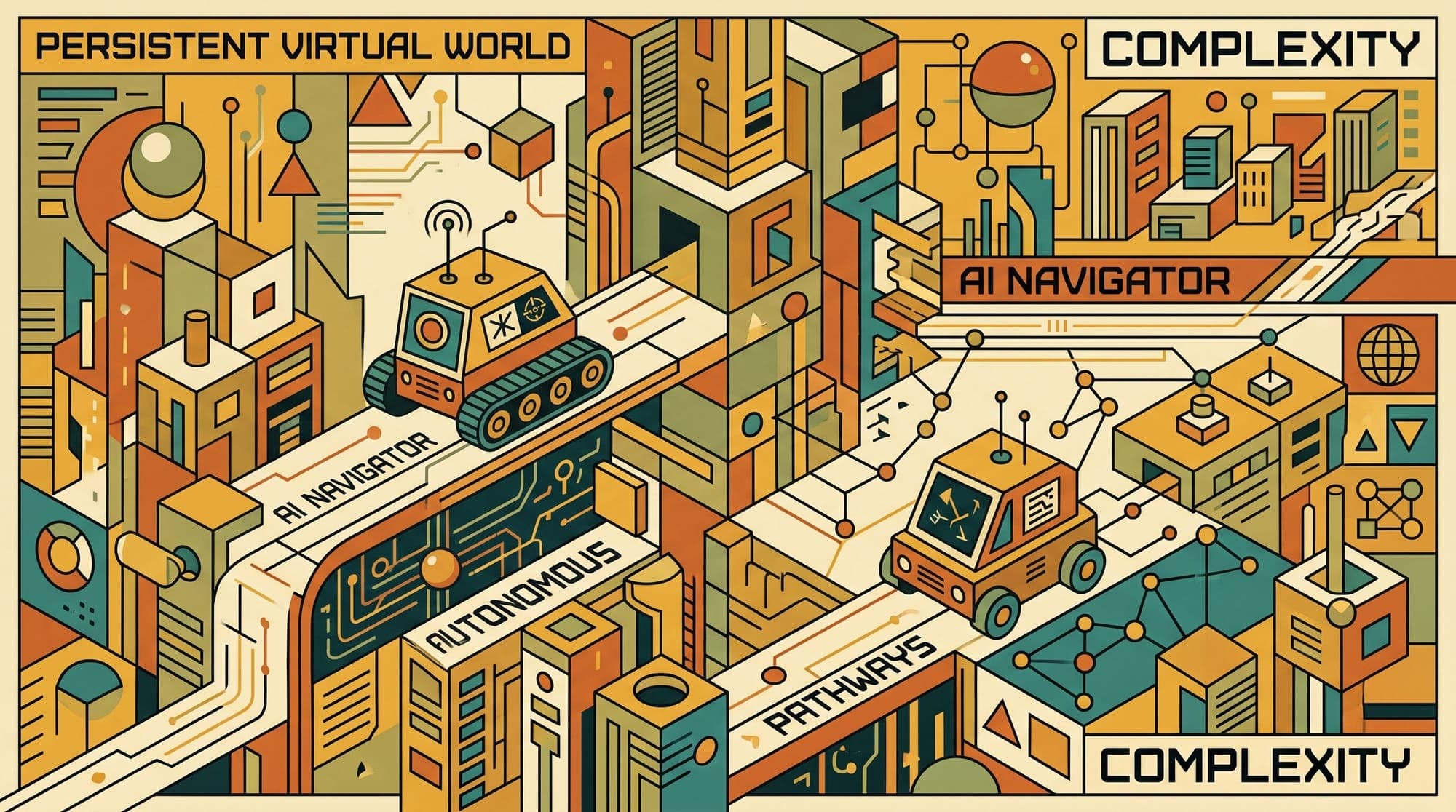
To test autonomous systems under conditions that mirror real-world complexity, DeepMind has partnered with Fenris Creations, the independent development studio behind EVE Online. EVE Online operates as a continuous, single-shard persistent universe that has run uninterrupted since 2003, featuring player-driven market economies, supply-and-demand logistics, and emergent diplomatic alliances across thousands of solar systems.
DeepMind identified four primary research frontiers that persistent virtual universes uniquely stress:
- Continual Learning: Acquiring new strategies and operational skills incrementally without suffering catastrophic forgetting as environmental dynamics shift.
- Extended Memory: Retaining and retrieving episodic information across time horizons that far exceed the context windows of modern transformer architectures.
- Long-Horizon Planning: Executing coordinated strategic objectives over weeks or months rather than immediate turn-by-turn or round-based payoffs.
- Complex Multi-Agent Dynamics: Navigating large-scale cooperation, competitive signaling, market negotiations, and social coordination among thousands of independent entities.
Staged Testing and Sandbox Deployment
The research partnership across the Fenris Creations ecosystem is structured in multiple progressive phases to isolate variables and prevent disruption to live human players:
- Offline Sandbox Instances: Research begins within isolated, offline builds of EVE Online, allowing agents to navigate full game mechanics in controlled environments separated from the public server population.
- EVE Frontier: The team plans to evaluate agents within EVE Frontier, an open-architecture environment featuring programmable "Smart Assemblies" where the underlying operational rules of the world can change dynamically.
- EVE Vanguard: Tactical, ground-level first-person environments provide a testbed for hierarchical architectures that combine rapid tactical decisions with long-term strategic objectives.
A player-facing prototype from the collaboration is already deployed: Aura Guidance, an onboarding system powered by Gemini that references curated Rookie Help exchanges to assist new players during initial game sessions. Full autonomous agent deployment into live game shards will remain gated until sandbox evaluations meet safety and capability benchmarks.