Google AI Overviews now appear in 43 percent of US searches

Google's AI-generated summaries now appear in 43 percent of US search results, up from 15 percent a year earlier, according to Similarweb's 2026 Generative AI Landscape report. The figure tracks the share of US searches displaying AI Overviews, the generated summaries that appear at the top of conventional Google results. Google also operates AI Mode, a separate conversational interface for longer queries and follow-up prompts, which uses a technique called query fan-out to split questions into

2 min
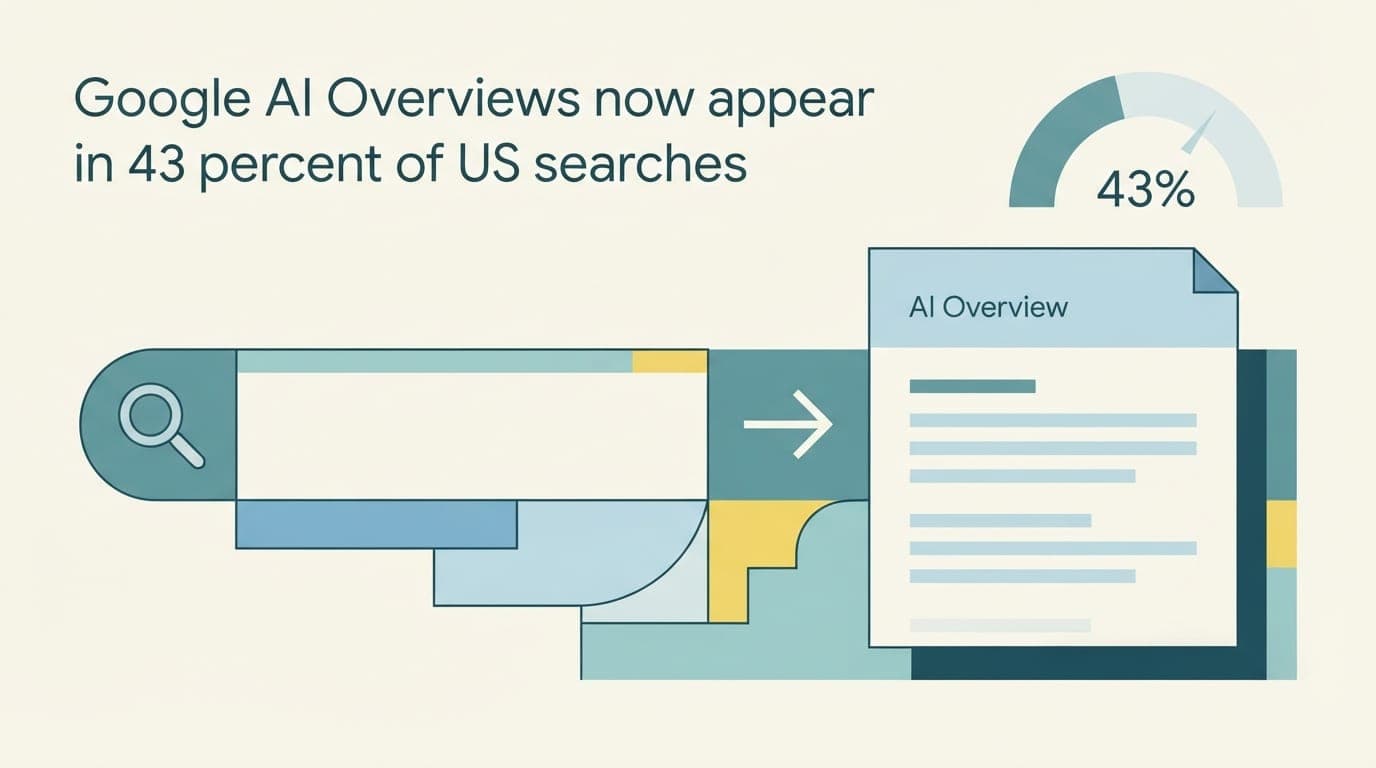
Google AI Overviews now appear in 43 percent of US searches

Google's AI-generated summaries now appear in 43 percent of US search results, up from 15 percent a year earlier, according to Similarweb's 2026 Generative AI Landscape report.

AI Overviews growth: 15% to 43% of US searches

The figure tracks the share of US searches displaying AI Overviews, the generated summaries that appear at the top of conventional Google results. Google also operates AI Mode, a separate conversational interface for longer queries and follow-up prompts, which uses a technique called query fan-out to split questions into subtopics and run multiple searches in parallel.

Similarweb estimated that visits to Google's AI Mode web experience grew from 126 million in June 2025 to 279 million in May 2026. Google separately reported in May that AI Mode had surpassed one billion monthly users, though that figure covers users rather than web visits and is not directly comparable.

The introduction of AI Mode correlated with a 5.4 percent increase in average Google search length, as users shifted toward longer natural-language queries resembling prompts used with AI assistants rather than traditional keyword combinations.

The broader generative AI market also grew. Similarweb estimated that generative AI websites received an average of 9.5 billion monthly visits between June 2025 and May 2026, up 70 percent year over year. Monthly unique visitors rose 57 percent to 655 million, and mobile app downloads increased 58 percent to 4.4 billion.

The report found that most ChatGPT users continued to use Google, with audience overlap among ChatGPT, Gemini, and Claude indicating that people use multiple services rather than committing exclusively to one platform.

Similarweb said its estimates draw on first-party analytics, anonymised device information, external data partnerships, and publicly available web data, meaning its figures are modelled estimates rather than direct counts from Google.

Sources

Google AI Overviews become more common in search - AI News

Similarweb 2026 Generative AI Landscape report - Similarweb

Written by

More to read

  • Normalizing Flows and Real NVP: How Invertible Neural Networks and Triangular Jacobians Compute Exact Log-Likelihoods

    Normalizing Flows and Real NVP: How Invertible Neural Networks and Triangular Jacobians Compute Exact Log-Likelihoods Generative modeling in deep learning revolves around a fundamental question: how can a neural network learn to transform a simple, analytically tractable probability distribution into a complex, high-dimensional empirical data distribution? Over the past decade, four primary generative modeling paradigms have emerged to address this challenge: 1. Generative Adversarial Networ

    1 min
  • Linus Torvalds Credits AI in Linux Kernel Commit After 24-Patch Driver Debug Session

    In a notable public milestone for AI-assisted systems programming, Linux creator Linus Torvalds credited an artificial intelligence model with doing the heavy analytical work during an intensive driver debugging session, allowing the model to author the commit message merged into the upstream kernel. The commit, titled drm/xe: Don't hand out the flat CCS storage as usable VRAM (commit 818bebeb63dd6bf5f4e07e145f6cdbace520a34c), resolves a memory allocation bug in the Intel Xe Direct Rendering Ma

    1 min
  • SGLang v0.5.18 Cuts LLM Cold Starts by 2.4x with Overlapped Weight Loading and CUDA Graph Capture

    The open-source LLM serving engine SGLang has released version 0.5.18, introducing an overlapped startup engine that significantly reduces cold-start latency for large language models, alongside communication kernel optimizations and expanded architecture support. Comprising 710 pull requests from 212 contributors, the release addresses operational overheads in LLM infrastructure where autoscaling, rolling cluster deployments, and worker node recovery frequently pay steep restart penalties. O

    1 min