Elon Musk's Grokipedia Hasn't Been Updated in Over Three Months

When Elon Musk launched Grokipedia in October 2025, he called it a "massive improvement" over Wikipedia. Eleven months later, the xAI-built AI encyclopedia appears to have been quietly abandoned, with no edits accepted since April 24. A Lawfare investigation found that across a sample of 34,519 pages containing 225,496 recommended edits, not a single correction has been accepted or rejected in more than three months. The site's own live page, which once tracked recent changes, now displays the

1 min
Elon Musk's Grokipedia Hasn't Been Updated in Over Three Months

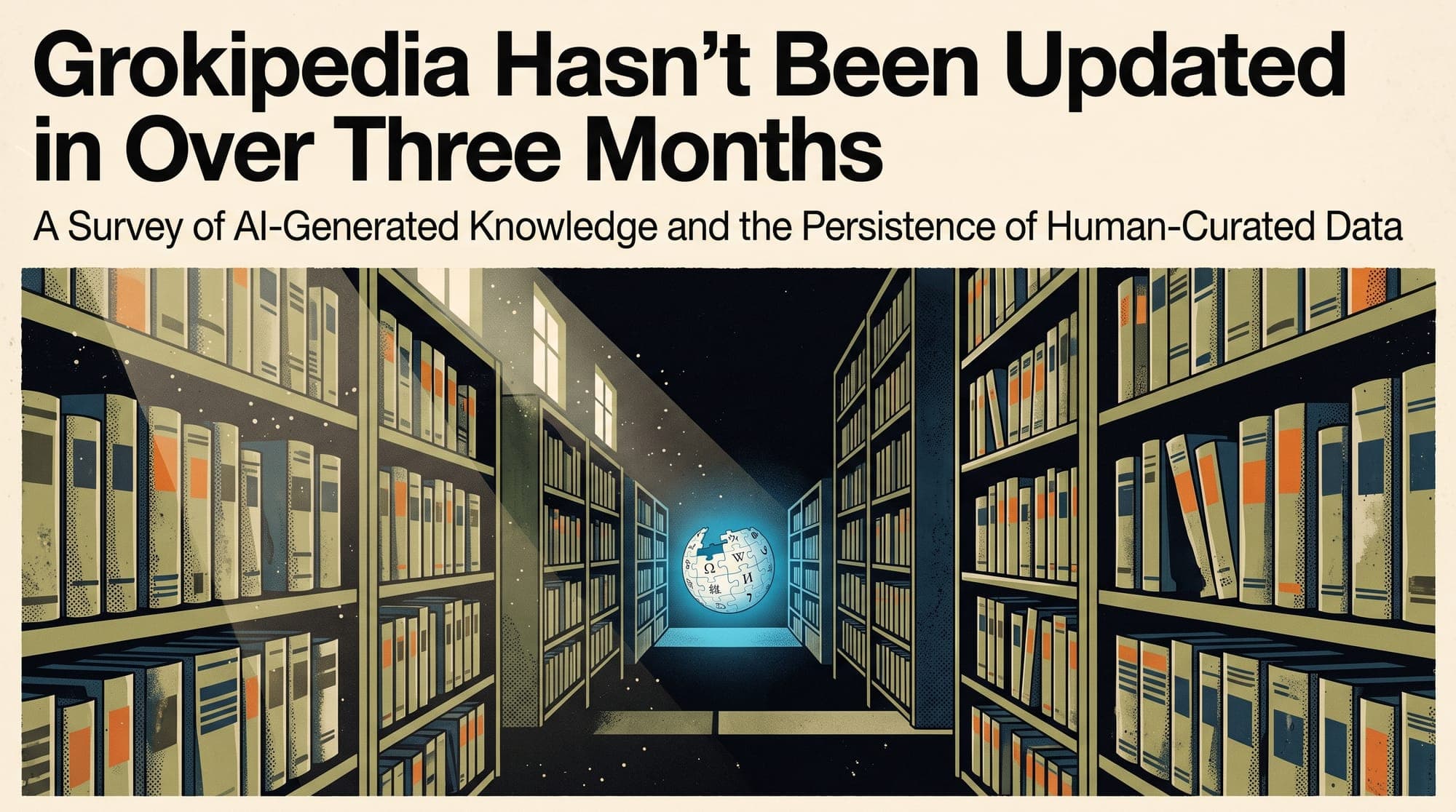
When Elon Musk launched Grokipedia in October 2025, he called it a "massive improvement" over Wikipedia. Eleven months later, the xAI-built AI encyclopedia appears to have been quietly abandoned, with no edits accepted since April 24.

A Lawfare investigation found that across a sample of 34,519 pages containing 225,496 recommended edits, not a single correction has been accepted or rejected in more than three months. The site's own live page, which once tracked recent changes, now displays the message "No live edits available right now."

Grokipedia launched with 885,000 AI-generated articles and later expanded to over 6 million entries with its v0.2 release in November 2025. Users can still suggest edits and new articles through the interface, but the review pipeline appears to have been switched off entirely. Lawfare's analysis found neither accepted nor rejected corrections dated after April.

Users on Reddit and X have been asking whether Grokipedia is "dead" for weeks. Musk himself last mentioned the project on X in February, according to Lawfare. xAI did not respond to a request for comment from The Verge.

The silent abandonment mirrors a pattern seen across other Musk ventures where ambitious product launches are followed by quiet neglect. Grokipedia was pitched as a direct competitor to Wikipedia, but without an editorial process its AI-generated entries stagnate while Wikipedia's community continues updating thousands of articles daily.

The project's apparent death also raises questions about the viability of AI-generated encyclopedias at scale. Without human review, machine-generated articles risk propagating errors, and without an active editing pipeline they cannot keep pace with current events. A static encyclopedia, AI-generated or not, stops being useful the moment it stops updating.

Sources

The Verge: Elon Musk's attempt at an AI Wikipedia hasn't been updated in months - https://www.theverge.com/ai-artificial-intelligence/976004/elon-musk-grokipedia-ai-wikipedia-not-updating-dead

Lawfare: Grokipedia Stopped Reviewing Edits in April. It Didn't Tell Anyone. - https://www.lawfaremedia.org/article/grokipedia-stopped-reviewing-edits-in-april.-it-didn-t-tell-anyone


Written by

More to read

  • Kakao Splits Into KakaoAI and KakaoX to Accelerate AI and Messenger Integration

    South Korean platform giant Kakao Corp. announced a corporate split that will separate its core operations into two independent publicly traded entities: KakaoAI and KakaoX. The restructuring, approved by Kakao's board of directors, aims to isolate and accelerate the company's artificial intelligence engineering and messaging ecosystem from its broader investment portfolio. Under the spin-off terms, existing shareholders will receive shares based on a net asset book value split ratio of 36% for

    1 min
  • US Warns 35 Partner Countries to Choose Between Pax Silica and China's WAICO AI Coalition

    The U.S. Department of State is preparing formal diplomatic notices instructing 35 partner nations to select between Washington's AI alliance and Beijing's competing framework. According to a draft cable reviewed by Reuters and reported by The Decoder and CNBC, the U.S. warns that countries joining China's newly established AI initiative will be excluded from the U.S.-led Pax Silica coalition. The diplomatic draft states: "To be part of everything is to be part of nothing. Signature of the Pax

    1 min
  • Asynchronous Batch Inference in Production: Architecture, Queue Scheduling, and Cost Arbitrage

    Asynchronous Batch Inference in Production: Architecture, Queue Scheduling, and Cost Arbitrage Interactive AI applications require low Time-to-First-Token (TTFT) and high inter-token generation speed to maintain responsive user experiences. Achieving sub-second latency targets forces infrastructure teams to overprovision GPU capacity to absorb peak demand spikes. However, non-interactive production workloads (such as historical document processing, embedding generation, nightly model evaluation

    1 min