When autonomous AI agent architectures scale from isolated single-agent loops to concurrent multi-agent fleets, systems engineering teams encounter a fundamental distributed systems reality: concurrency bugs in language models do not merely produce dirty reads. They produce reasoning corruption, circular delegation deadlocks, and cascading execution failures.
In single-agent execution pipelines, control flow is strictly sequential: retrieve context, prompt the model, parse tool arguments, apply side effects, and observe outcomes. In production multi-agent systems, where specialized agents concurrently review pull requests, triage customer tickets, or manage database migrations, multiple autonomous loops interact over shared mutable state.
Without formal concurrency control, agents generate actions based on snapshots that become invalid while the model is still streaming tokens. Solving this requires adapting classical distributed locking primitives, including semantic mutexes, monotonic fencing tokens, wait-for graph cycle detection, and distributed saga rollbacks, to the unique latency profiles of large language models.
Why Concurrency Fails in Multi-Agent Pipelines
Traditional software threads operate with sub-millisecond execution windows. Database row locks or in-memory mutexes are held for microseconds during ACID transactions. In contrast, an AI agent executing a complex reasoning-and-tool step typically requires between 3 and 30 seconds of inference and validation time.
Holding raw database row locks or infrastructure-level mutexes across LLM inference cycles causes severe database connection pool exhaustion and downstream timeout cascades. Conversely, executing agents without locking introduces three primary concurrency failure modes:
+-------------------------------------------------------------------------------+
|                      CONCURRENCY BREAKDOWNS IN AI AGENTS                      |
+-------------------------------------------------------------------------------+
|                                                                               |
|  1. Reasoning Divergence & Stale Action Payloads                              |
|     Agent A reads State S_0 (t=0s) ---> Generates Plan (t=12s) ---> Writes S_A |
|     Agent B reads State S_0 (t=1s) ---> Writes State S_B (t=4s)                |
|     Result: Agent A overwrites S_B based on obsolete initial state.           |
|                                                                               |
|  2. Circular Delegation Deadlock (Wait-For Loop)                              |
|     Agent A (Workflow Lead) waiting on Agent B (Code Analysis)                 |
|     Agent B waiting on Agent C (DB Schema Verification)                       |
|     Agent C delegates clarification back to Agent A                           |
|     Result: Execution stalls indefinitely until global timeout.               |
|                                                                               |
|  3. Double-Spend & Uncoordinated Tool Execution                              |
|     Two triage agents process the same customer refund concurrently.          |
|     Both verify balance > 0, and both issue external Stripe refund APIs.      |
|     Result: Duplicate irreversible financial side effects.                    |
|                                                                               |
+-------------------------------------------------------------------------------+
1. Reasoning Divergence
An agent queries customer ticket state at time t=0, receiving an "Open - Unassigned" status. The model takes 14 seconds to analyze past conversation history and format a multi-step resolution. Meanwhile, at t=3, a second agent or human operator assigns and closes the ticket. At t=14, the first agent executes external tool actions against the ticket, executing invalid state transitions or overriding recent user communication.
2. Circular Delegation Deadlocks
In swarm or hierarchical orchestrations where agents can dynamically delegate sub-tasks, circular dependencies emerge. Agent A (Task Router) delegates a complex refactoring subtask to Agent B (Backend Specialist). Agent B requires database schema validation and delegates to Agent C (Database Specialist). Agent C encounters ambiguous API contracts and delegates clarification back to Agent A. If each agent holds its execution thread open while awaiting upstream responses, the entire workflow enters a permanent deadlock.
3. Asymmetric Tool Side Effects
Unlike database transactions that support atomic rollbacks, external agent tool calls (sending Slack alerts, committing Git changes, triggering cloud deployments, executing payment webhooks) alter real-world environments. When concurrent agents execute overlapping tool actions, systems face non-deterministic state divergence that cannot be undone by simple database restarts.
The Semantic Mutex: Token-Based Orchestration Locks
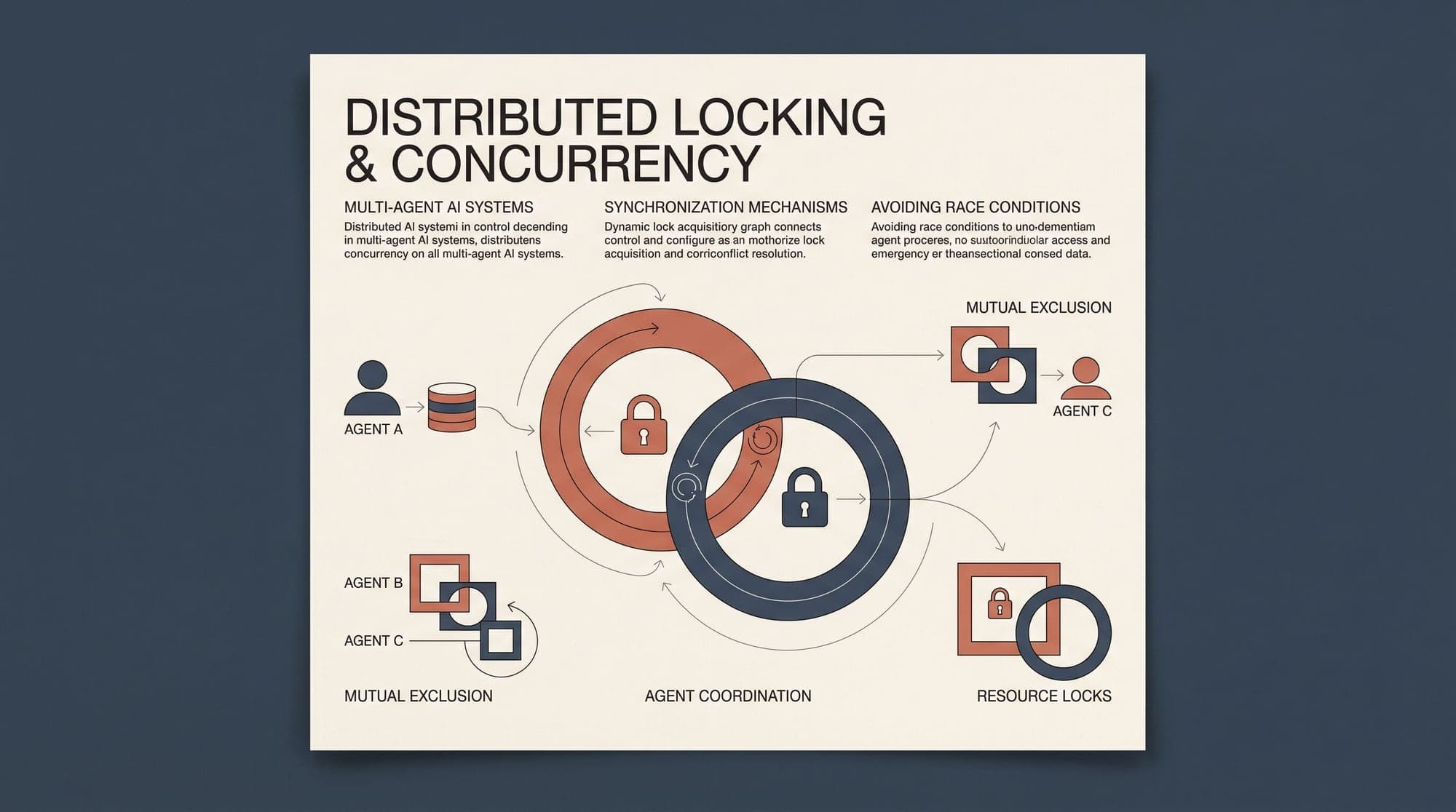
To avoid connection starvation in relational databases, production systems decouple concurrency management from the storage layer. Instead of acquiring database-level row locks, the orchestrator implements a Semantic Mutex (or agentic lock) at the workflow boundary.
A semantic mutex locks a logical domain boundary represented by a unique string token (such as ticket:cust_8492, repo:services/auth, or tenant:9182:billing) rather than a physical database row.

Key Mechanics of Semantic Mutexes
- Pre-Inference Lock Acquisition: Before an agent constructs its prompt or issues an LLM API call, it requests an exclusive or shared lease on the target semantic token from a distributed coordinator (such as Redis or Etcd).
- Lock Rejection Queuing: If another agent holds an exclusive lease on
ticket:cust_8492, the incoming agent does not spinlock. The orchestrator suspends the agent's task state, enqueues the request into a prioritized FIFO queue, and releases compute resources. - Post-Acquisition Context Refresh: When the lock is finally acquired, the orchestrator forces a fresh retrieval pass. The waiting agent is never resumed with stale context gathered prior to queueing; it receives the updated domain state reflecting the preceding agent's modifications.
Fenced Leases and Monotonic Epoch Counters
A major vulnerability in distributed systems with variable execution latency is the "zombie agent" problem. If an agent acquires a lock with a 30-second Time-To-Live (TTL), but encounters API throttling, slow inference, or high network latency lasting 35 seconds, its lease expires. The coordinator grants the lock to a second agent. When the first agent finally finishes token generation, it executes its tool actions, overwriting the new agent's work.
Following distributed systems principles outlined by Martin Kleppmann on distributed locking, semantic locks must incorporate Monotonic Fencing Tokens.
+-----------------------------------------------------------------------------+
|               FENCED LEASE VALIDATION IN TOOL EXECUTION GATEWAYS            |
+-----------------------------------------------------------------------------+
|                                                                             |
|  1. Coordinator Issues Monotonic Token:                                      |
|     Agent A acquires lock on "account:482" ---> Receives Fencing Token = 101 |
|     Agent A stalls on slow LLM reasoning (lease expires at t=30s)           |
|                                                                             |
|  2. Reassignment Under High Latency:                                        |
|     Agent B acquires lock on "account:482" ---> Receives Fencing Token = 102 |
|     Agent B completes tool execution with Token 102 ---> Accepted & Stored  |
|                                                                             |
|  3. Gateway Rejection of Zombie Agent:                                       |
|     Agent A resumes and sends Tool Request with Token 101                   |
|     Execution Gateway checks: Token(101) < LastSeenToken(102)               |
|     Action REJECTED: Zombie execution prevented.                            |
|                                                                             |
+-----------------------------------------------------------------------------+
When an agent requests a lease, the coordinator increments and returns a strictly increasing integer (the epoch counter). When the agent submits tool actions to the tool execution gateway, the gateway verifies that the agent's fencing token is greater than or equal to the highest token processed for that resource. Any delayed write from an expired lease is rejected at the execution boundary.
Deadlock Prevention: Wait-For Graphs and Global Lock Ordering
In multi-agent systems with dynamic subtask delegation, simple timeouts are insufficient for deadlock handling. Relying solely on 60-second timeouts means deadlocked workflows burn unnecessary compute, delay user responses, and congest shared queues.
Production architectures employ proactive deadlock prevention and detection through two primary mechanisms:
1. Global Lexicographical Lock Ordering (Two-Phase Locking)
If an agent workflow requires access to multiple resources simultaneously (for example, modifying repo:services/auth and repo:services/billing), all agents across the organization must acquire locks in a globally defined lexicographical order. By preventing the classic hold-and-wait circular condition (Agent 1 holds A and waits for B; Agent 2 holds B and waits for A), multi-resource deadlocks are mathematically eliminated prior to execution.
2. Runtime Wait-For Graph (WFG) Cycle Detection
For dynamic swarms where lock requirements cannot be predicted in advance, the orchestration coordinator maintains a directed graph G = (V, E), where vertices V represent active agents and directed edges E = (Agent_i -> Agent_j) represent Agent_i waiting on a resource or task completion from Agent_j.
Directed Wait-For Graph:
  Agent_1 (Routing) ----> Agent_2 (Refactoring)
     ^                          |
     |                          v
  Agent_4 (Documentation) <-- Agent_3 (Testing)

Cycle Detected: [Agent_1 -> Agent_2 -> Agent_3 -> Agent_4 -> Agent_1]
Action: Terminate lowest-priority edge (Agent_4) and trigger compensating saga.
The coordinator runs Tarjan's Strongly Connected Components (SCC) or depth-first cycle detection on every edge insertion. When a cycle is detected, the engine breaks the circular wait immediately:
- Identifies the lowest-priority or most recently spawned agent in the cycle.
- Cancels its pending request and revokes its held leases.
- Injects a structured exception into the agent's context window:
Error: Circular dependency detected with Agent_X. Aborting subtask. - Executes compensating rollback actions.
Optimistic Concurrency Control (OCC) for Read-Heavy Agent Fleets
While pessimistic semantic locking is mandatory for high-risk write operations (financial transactions, infrastructure changes, destructive file updates), it introduces queuing latency in high-throughput workflows.
For read-heavy workloads (such as multiple agents analyzing the same documentation codebase or generating competing draft proposals), Optimistic Concurrency Control (OCC) provides superior throughput.
+-------------------------------------------------------------------------------+
|             OPTIMISTIC CONCURRENCY CONTROL (OCC) FOR AGENT FLEETS             |
+-------------------------------------------------------------------------------+
|                                                                               |
|  Step 1: Snapshot Ingestion                                                  |
|  Agent reads resource state + snapshot hash: H_0 = SHA256(ResourceState)      |
|                                                                               |
|  Step 2: Autonomous Inference                                                |
|  Agent spends 15 seconds generating proposed modifications locally.          |
|                                                                               |
|  Step 3: Commit Phase with Atomic Validation                                  |
|  Agent submits: Commit(Target="doc:architecture", BaseHash=H_0, Patch=Delta)  |
|                                                                               |
|  Step 4: Verification Gate                                                    |
|  IF CurrentHash("doc:architecture") == H_0:                                   |
|      Apply Patch & Increment Version                                          |
|  ELSE:                                                                        |
|      Reject Commit ---> Trigger Rebase & Context Refresh Loop                 |
|                                                                               |
+-------------------------------------------------------------------------------+
Under OCC, agents do not hold locks during inference. Instead, each state object carries a cryptographic version hash or vector clock. If the underlying data changes during the agent's reasoning cycle, the commit gateway rejects the write.
Rather than failing the workflow, the orchestrator executes an automated Rebase Loop: the new state diff is prepended to the agent's context window, prompting the model to evaluate whether its intended changes remain valid under the updated state.
Concurrency Patterns: Architectural Comparison
Pessimistic Semantic Mutex
- Latency Overhead: Medium (queue waiting under contention).
- Deadlock Vulnerability: Prevented via lease TTLs and lock ordering.
- State Consistency: Strict serializability across domain entities.
- Ideal Profile: High-risk writes, financial tools, production infrastructure updates.
Optimistic Concurrency Control (OCC)
- Latency Overhead: Zero pre-inference queue latency.
- Deadlock Vulnerability: Zero deadlock risk (no held locks).
- State Consistency: Validated atomic commits with rebase fallbacks.
- Ideal Profile: Read-heavy pipelines, documentation generation, parallel drafting swarms.
Wait-For Graph (WFG) Coordinator
- Latency Overhead: Low (linear cycle detection checks upon delegation).
- Deadlock Vulnerability: Actively detected and resolved via automated edge preemption.
- State Consistency: Strict multi-resource consistency.
- Ideal Profile: Complex hierarchical swarms, recursive sub-agent delegation.
Ephemeral Copy-on-Write Sandboxes
- Latency Overhead: High (sandbox and container provisioning).
- Deadlock Vulnerability: Zero deadlock risk during execution.
- State Consistency: Branch isolation resolved at deterministic merge boundaries.
- Ideal Profile: Autonomous coding agents, repository refactoring, test execution.
Production Implementation Blueprint
Building robust concurrency controls for production multi-agent systems requires establishing clear boundary enforcement across five architectural layers:
[ Ingestion & Orchestration Layer ]
  |-- Generates Task IDs & Dependency Topologies
  v
[ Distributed State & Mutex Coordinator (Redis / Etcd) ]
  |-- Manages Semantic Token Leases, TTL Heartbeats, and Monotonic Tokens
  |-- Maintains Real-Time Wait-For Graph (WFG) & Cycle Detection
  v
[ Agent Reasoning Core (LLM Inference) ]
  |-- Executes decoupled from database locks
  |-- Employs bounded generation timeouts
  v
[ Execution Gateway & Fencing Verifier ]
  |-- Validates Fencing Tokens (Epoch Verification)
  |-- Verifies OCC Snapshot Hashes before tool invocation
  v
[ Tool Environment & Rollback Sagas ]
  |-- Executes validated side effects
|-- Registers compensating transactions for automated rollback- Keep Locks Semantic, Not Relational: Never allow an LLM API call to occur inside an open SQL transaction. Always acquire semantic domain tokens at the orchestration boundary.
- Mandate Fencing on All External Tool Gateways: Every tool integration that performs external mutations must require and validate a monotonic epoch token issued by the lease manager.
- Equip Agents with Rejection Recovery Prompts: When an agent's OCC commit or lock acquisition fails, design error handlers that return structured JSON diagnostics. This enables the model to self-correct and re-plan rather than crashing the workflow.
- Isolate Code and File Operations in Ephemeral Branches: For coding agents, avoid locking shared files entirely. Route each agent into an isolated Git worktree or container sandbox, resolving concurrent modifications at deterministic merge boundaries.
As agent systems shift from experimental scripts into enterprise-scale multi-worker swarms, concurrency and locking protocols become the critical barrier between reliable automation and catastrophic state corruption.
Sources
- Christopher Meiklejohn on Distributed Systems Problems in Multi-Agent Systems: christophermeiklejohn.com
- Ninelayer on The Agentic Mutex and Race Conditions in Multi-Agent Workflows: ninelayer.in
- Martin Kleppmann on Distributed Locking and Fencing Tokens: martin.kleppmann.com
- LLM-Driven Deadlock Detection and Resolution in Multi-Agent Systems: arXiv:2503.00717
- Etcd Distributed Concurrency, Leases, and Software Architecture: etcd.io
- Redis Distributed Locks (Redlock) Specification: redis.io