San Francisco AI research startup Deep Cogito has raised a $43 million Series A round to expand its post-training systems and reinforcement learning infrastructure for open-weight foundation models.
The round was led by TQ Ventures, with participation from Benchmark, Nexus Venture Partners, Atreides Management, South Park Commons, and enterprise cloud security provider Zscaler, which acts as both a commercial customer and strategic investor. The financing brings total capital raised by Deep Cogito to more than $56 million.
Post-Training and Iterated Distillation
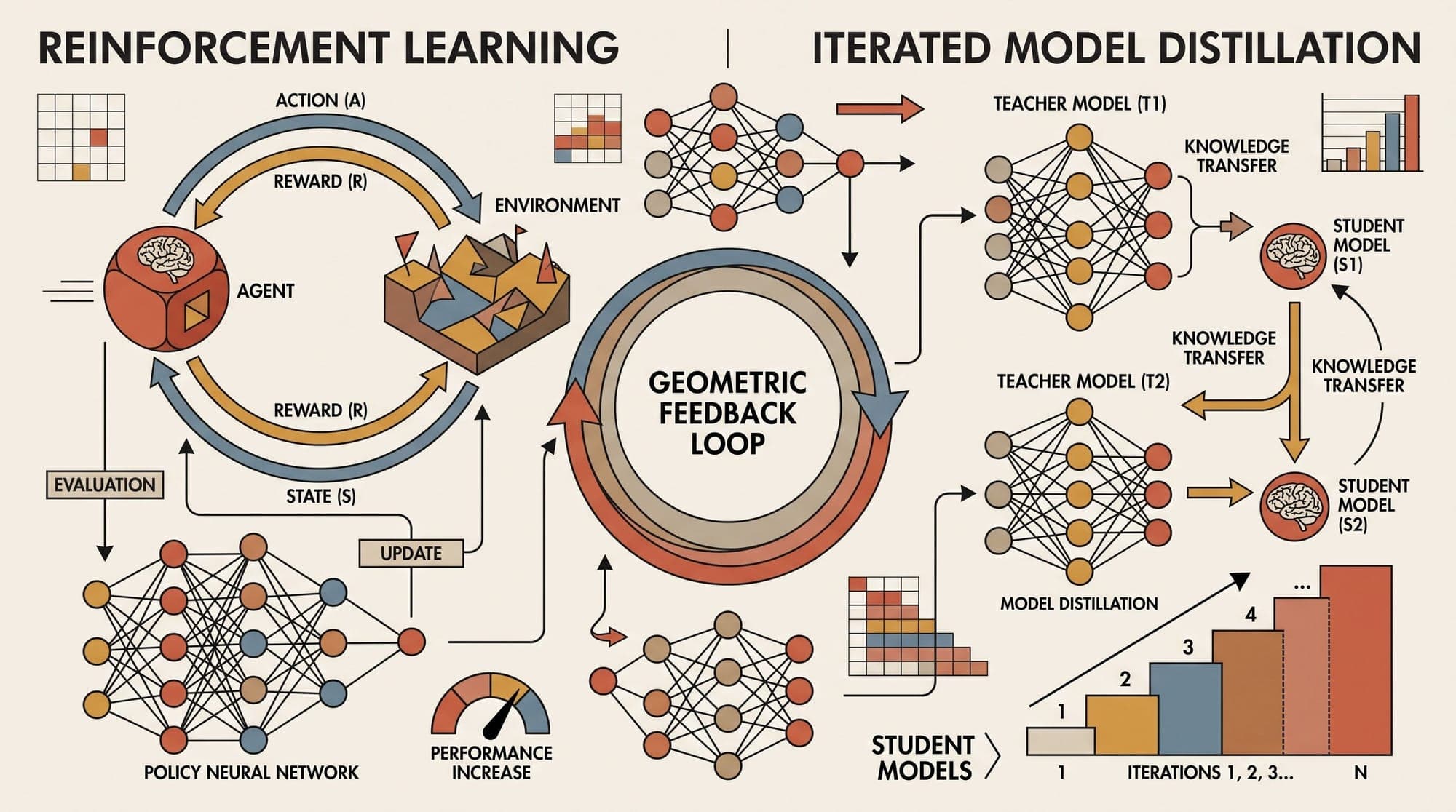
Founded by former Google AI Search engineers Drishan Arora and Dhruv Malrana, Deep Cogito focuses on improving foundation model reasoning after pre-training completes. Rather than allocating capital toward large pre-training compute runs, the team targets post-training optimization via Iterated Distillation and Amplification (IDA).
   ┌────────────────────────────────────────────────────────┐
   │                                                        ▼
[ Base Weights ] ──► [ Amplification: Search & Compute ] ──► [ Verified Trajectories ]
                             ▲                                      │
                             └──────── [ Distillation Loop ] ───────┘
Under the IDA framework, the system amplifies reasoning capability during training by allocating extended search compute to explore complex problem spaces. Successful reasoning paths are subsequently distilled directly back into the model's baseline weights. This allows the model to internalize productive heuristic patterns, reducing the token overhead and inference latency typically required by test-time compute scaling.

Cogito Open-Weight Model Family
The company validates its post-training pipelines through the Cogito model family, spanning parameters from 3 billion to a 671-billion-parameter Mixture-of-Experts (MoE) architecture:
- Cogito v2 (671B MoE): Produced reasoning chains approximately 60% shorter than DeepSeek R1 while preserving benchmark accuracy across reasoning tasks.
- Cogito v2.1 (671B MoE): Integrates process supervision during step-by-step reasoning on top of open-weight DeepSeek base models.
- Training Economics: Deep Cogito reported spending under $3.5 million in total compute across eight models in the initial Cogito release series.
Enterprise Weight Customization
In parallel with open-weight releases, Deep Cogito builds proprietary models for enterprise customers. Instead of relying exclusively on Retrieval-Augmented Generation (RAG) at runtime, the platform trains specialized domain workflows, security policies, and task evaluation criteria directly into model parameters.
Customer and backer Zscaler utilizes the platform to train dedicated security intelligence models on internal threat telemetry and incident data.
Deep Cogito plans to use the new capital to scale its compute clusters, expand algorithmic research into process-supervised reinforcement learning, and accelerate deployment of specialized enterprise models.