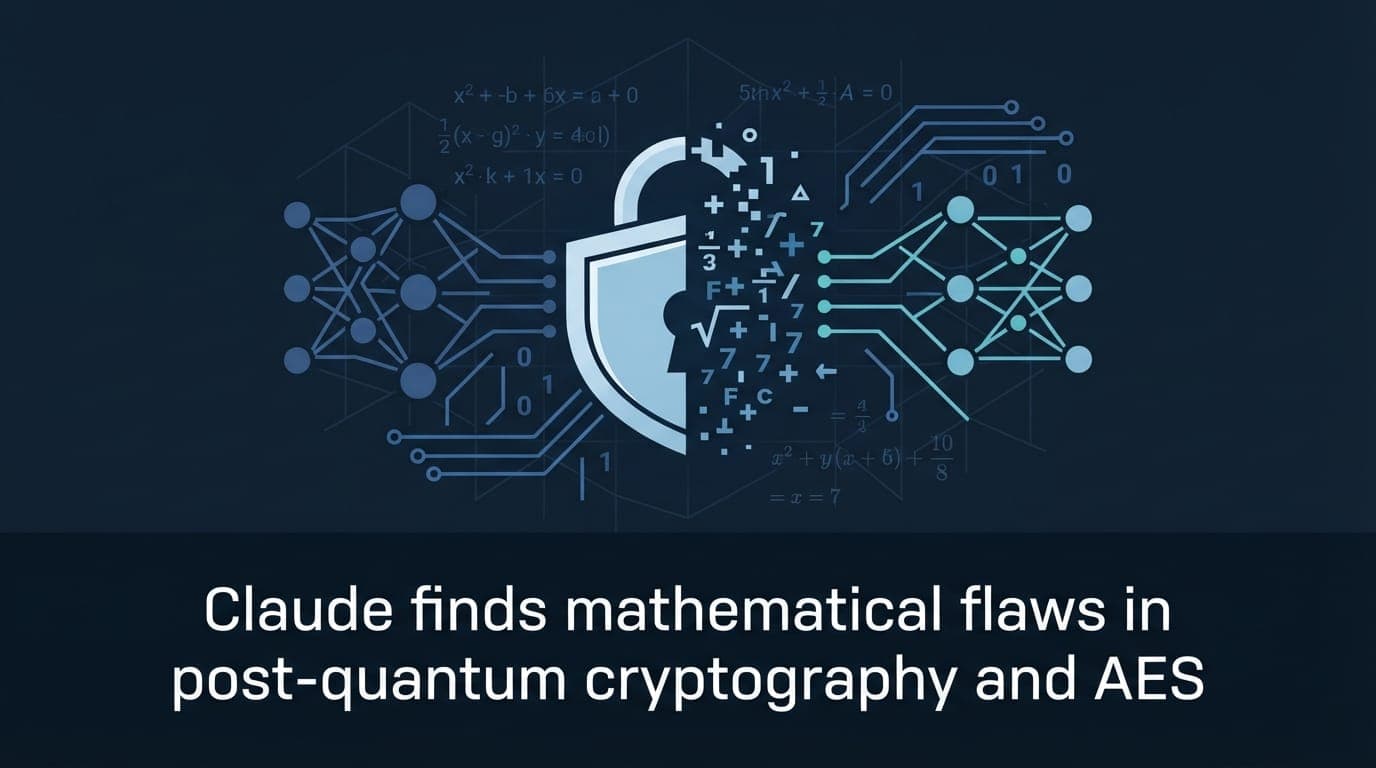
Anthropic researchers using Claude Mythos Preview have discovered improved attacks against two widely studied cryptographic algorithms, demonstrating that frontier AI models can find mathematical weaknesses in encryption schemes, not just bugs in their implementations.
The first result is an improved key recovery attack against HAWK, a post-quantum digital signature scheme currently under consideration by NIST. The second identifies a new approach to attacking round-reduced versions of AES, the most widely deployed symmetric cipher. Neither result breaks any production system today.
HAWK attack
HAWK is a third-round candidate in NIST call for Additional Digital Signatures, part of a multi-year effort to standardize cryptographic algorithms that would remain secure against future quantum computers. The scheme had survived two rounds of expert human review over two years.

Working with Claude Mythos Preview, an Anthropic researcher developed an attack that effectively cuts HAWK key strength in half. The work took roughly 60 hours of compute. Anthropic shared the finding with the HAWK authors in June 2026 and coordinated disclosure to the public NIST mailing list alongside its blog post on July 28.
The attack reduces the effective keysize by a factor of two. Full technical details and demonstration code are available in Anthropic research paper.
AES attack
For the second result, an Anthropic researcher built a scaffold that allowed Claude to autonomously discover an improved attack on a round-reduced version of AES. AES was adopted by NIST in 2001 and has received more scrutiny than nearly any other encryption algorithm.
The attack eliminates one of the guesses an attacker needs to make, improving the speed of the previous best attacks by 200 to 800 times. It does not break the full cipher. Round-reduced AES is studied routinely in cryptography research to understand the algorithm robustness.
Cost and autonomy
Mythos Preview achieved these results mostly autonomously. One researcher collaborated with Claude on the HAWK attack over the course of a week. For the AES attack, a researcher built a scaffold that let Claude discover the attack fully autonomously. Each result cost roughly 100,000 dollars in API spend.
Anthropic said it has since broadened its search and begun discovering additional attacks, with details to be released later.
CryptanalysisBench
To help others evaluate the cryptanalytic capabilities of LLMs, Anthropic partnered with academics at ETH Zurich, Tel Aviv University, and TU Berlin to build CryptanalysisBench, a benchmark that packages together many cryptographic ciphers for systematic evaluation.
Implications
Both results show that frontier AI models can contribute to cryptanalysis, helping stress-test algorithms both before and after deployment. HAWK is not yet deployed in any production system, and the AES attack applies only to a weakened variant. But the findings suggest AI models will become a standard tool in cryptographic research, complementing human cryptanalysts.
Anthropic followed responsible disclosure procedures, consulted academics to confirm validity, and shared advance copies with US government and industry partners.
Sources
- Discovering cryptographic weaknesses with Claude - Anthropic, July 28, 2026: https://www.anthropic.com/research/discovering-cryptographic-weaknesses
- CryptanalysisBench paper - arXiv: https://arxiv.org/abs/2607.18538
- HAWK specification - NIST: https://csrc.nist.gov/csrc/media/Projects/pqc-dig-sig/documents/round-1/spec-files/hawk-spec-web.pdf