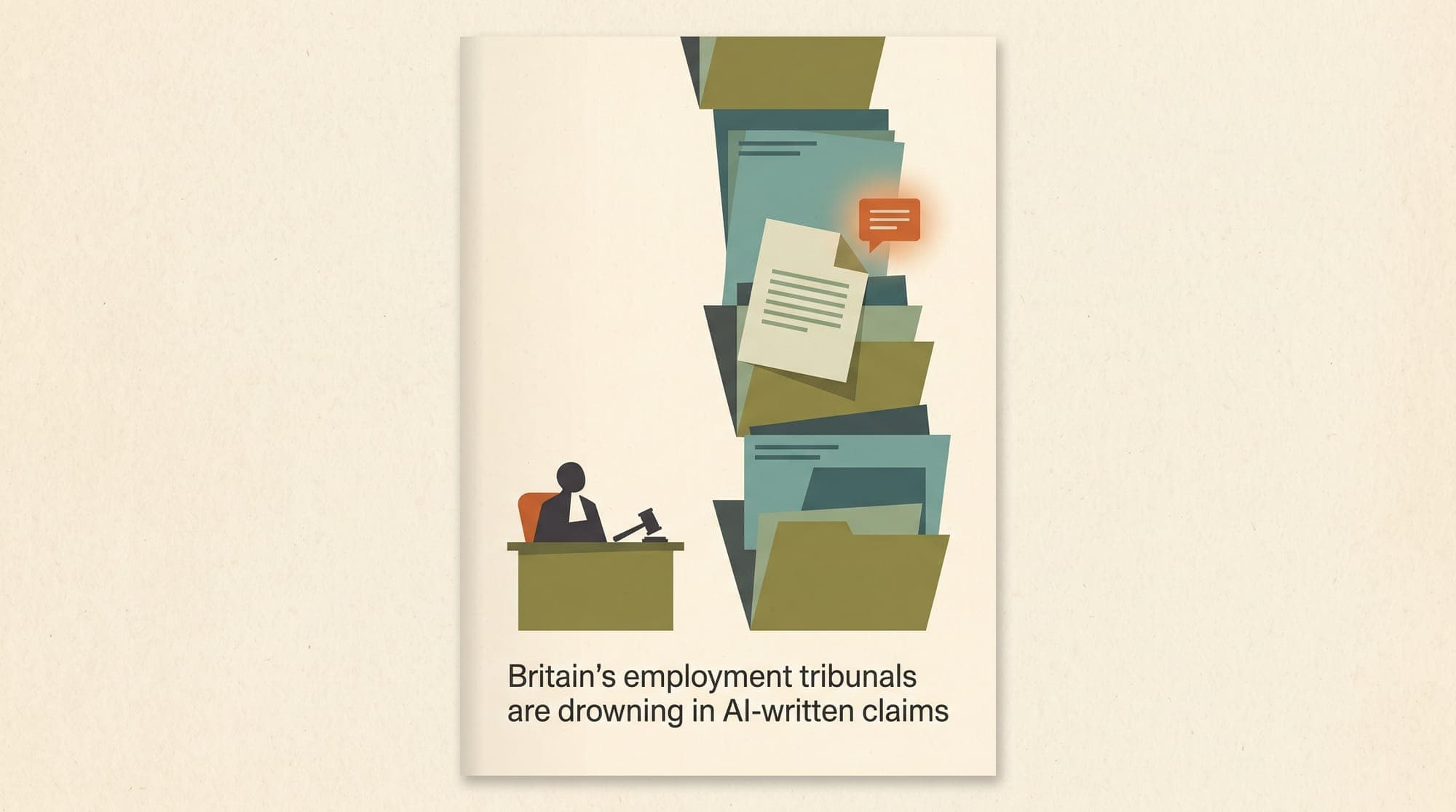
Britain's employment tribunals are drowning in AI-written claims

Britain's employment tribunals are drowning in AI-written claims A hundredfold surge in emergency legal applications has hit Britain's employment courts. Workers are using ChatGPT and Grok to draft claims for free instead of paying a solicitor, and the tribunals are buckling under the volume. Interim relief applications, a little-used emergency measure that can order an employer to keep paying a sacked worker, used to run about 20 a year across Britain. They now arrive in the thousands. Tribun

1 min
Britain's employment tribunals are drowning in AI-written claims

Britain's employment tribunals are drowning in AI-written claims

A hundredfold surge in emergency legal applications has hit Britain's employment courts. Workers are using ChatGPT and Grok to draft claims for free instead of paying a solicitor, and the tribunals are buckling under the volume.

Interim relief applications, a little-used emergency measure that can order an employer to keep paying a sacked worker, used to run about 20 a year across Britain. They now arrive in the thousands. Tribunal presidents Barry Clarke and Susan Walker flagged the shift in a memo reported by The Economist. Across the year to March 2026, total claims rose 39 percent and the unresolved backlog jumped 55 percent to 64,000 cases.

Many of the AI-drafted filings are bloated and unreliable. Some run to hundreds of pages and cite laws that do not exist, with demands far outside what tribunals can award. The friction lands on everyone: legitimate claimants wait longer for a hearing, and employers pay to defend claims whether or not they have merit.

The pressure is about to grow. Labour's Employment Rights Act adds roughly 25 new grounds for claims and removes compensation caps. The Economist described the dynamic as a "tragedy of the commons, AI edition," where a free tool spent by individuals collectively degrades a shared public system.

Britain is not alone. A US federal judge called AI-generated litigation an "existential threat to the federal courts." But the effect is not uniformly negative: a study in Pakistan found that judges given AI tools and training cleared backlogs faster, suggesting the problem is adoption without guardrails, not the technology itself.

Sources

Written by

More to read

  • xLSTM: How Exponential Gating and Matrix Memory Scale Recurrent Neural Networks

    xLSTM: How Exponential Gating and Matrix Memory Scale Recurrent Neural Networks For over two decades following its introduction by Hochreiter and Schmidhuber (1997), the Long Short-Term Memory (LSTM) network served as the dominant architecture for sequence modeling. By introducing the constant error carousel and multiplicative gating, LSTMs mitigated the vanishing gradient problem that plagued vanilla recurrent neural networks. However, the emergence of the Transformer architecture (Vaswani et

    1 min
  • Anthropic Nears $7B Acquisition of AI Infrastructure Startup Decart Ahead of IPO

    Anthropic is finalizing negotiations to acquire Israeli artificial intelligence infrastructure startup Decart in a transaction valued at approximately $7 billion, according to reporting from Calcalist and Reuters. The acquisition, expected to be settled primarily in Anthropic equity, would mark the Claude developer's largest purchase to date as it prepares for a planned initial public offering. Founded in September 2023 by Dr. Dean Leitersdorf and Moshe Shalev, Decart specializes in hardware-ag

    1 min
  • LLM Inference on AMD ROCm in Production: MI300X Architecture, Triton Kernel Parity, and vLLM Serving Benchmarks

    LLM Inference on AMD ROCm in Production: MI300X Architecture, Triton Kernel Parity, and vLLM Serving Benchmarks Serving frontier large language models in enterprise production has historically been synonymous with NVIDIA CUDA infrastructure. However, the deployment of AMD Instinct MI300X accelerators across tier-one hyperscalers and neoclouds has established a viable alternative for high-throughput inference fleets. With 192 GB of high-bandwidth memory (HBM3) and 5.3 TB/s of peak theoretical m

    1 min