Apple Music Mandates AI Transparency Tags Across Tracks, Compositions, and Artwork

Apple Music has notified record labels and distribution partners that it is introducing mandatory AI transparency tags across its ingestion pipeline, establishing visible indicators for synthetic audio and visual assets later this year. Under the updated ingestion specifications, content providers must declare when artificial intelligence tools have been used to generate a material portion of a release. Four-Tier Metadata Taxonomy The framework establishes distinct metadata flags across four

1 min
Apple Music Mandates AI Transparency Tags Across Tracks, Compositions, and Artwork

Apple Music has notified record labels and distribution partners that it is introducing mandatory AI transparency tags across its ingestion pipeline, establishing visible indicators for synthetic audio and visual assets later this year.

Under the updated ingestion specifications, content providers must declare when artificial intelligence tools have been used to generate a material portion of a release.

Four-Tier Metadata Taxonomy

The framework establishes distinct metadata flags across four creative layers of catalog delivery:

  1. Track: Identifies synthetic generation within the master sound recording at the individual track level.
  2. Composition: Flags machine-generated lyrical content, melodic structures, or compositional scoring.
  3. Artwork: Applies at the album release level for AI-generated static packaging or animated motion art.
  4. Music Video: Categorizes standalone or bundled video assets produced using generative visual models.
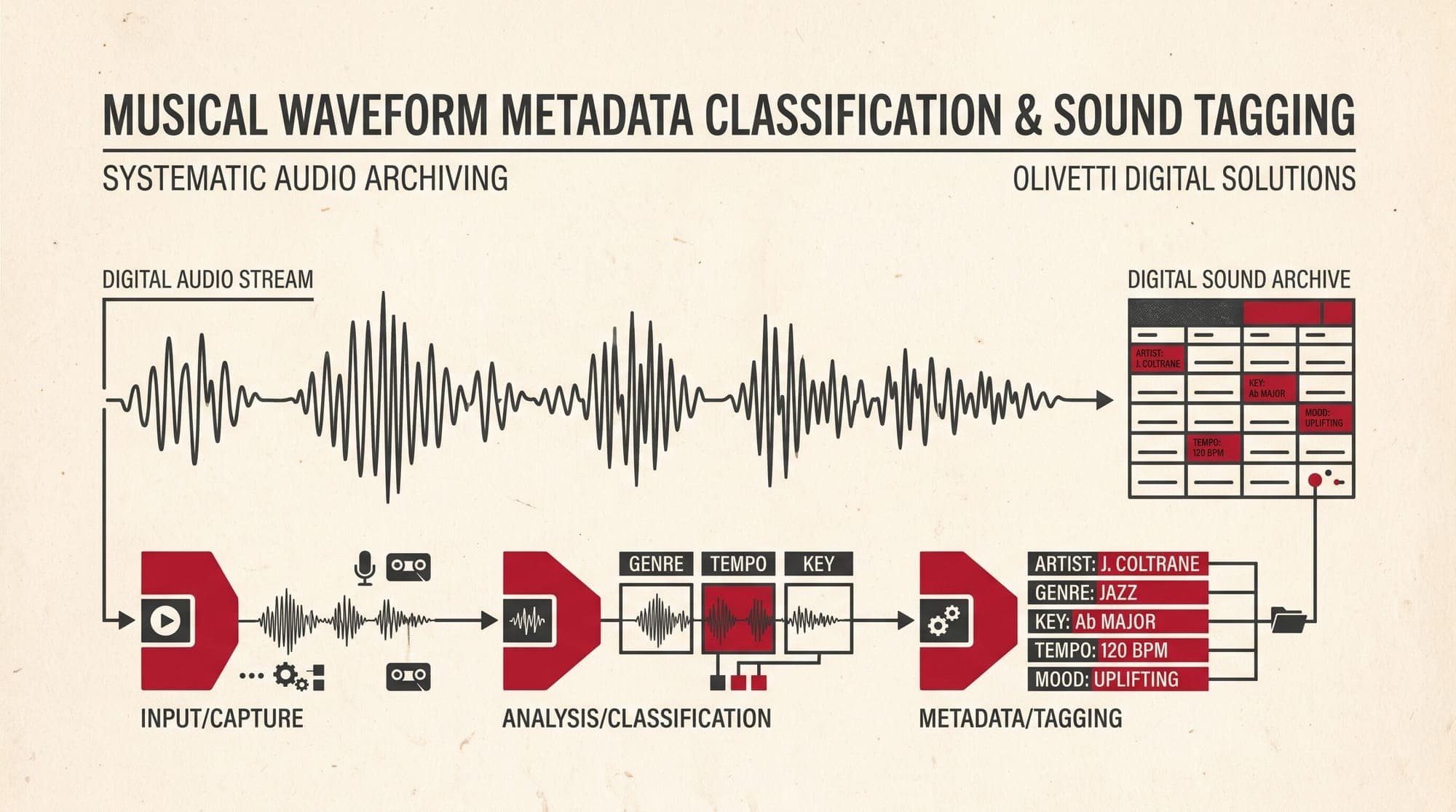
Four-category AI metadata taxonomy for streaming media distribution

Distributors and record labels are permitted to apply multiple tags concurrently across a single release package.

Upstream Verification and Catalog Scale

In communication with partners, Apple stated that it will rely on upstream content distributors to apply the tags during catalog delivery, treating AI disclosures similarly to conventional metadata fields such as genres, songwriter credits, and explicit content flags.

The labeling system addresses an influx of synthetic tracks across commercial streaming networks. Apple Music executive Oliver Schusser previously disclosed that fully synthetic audio accounted for more than a third of monthly content submissions to the platform.

Once the consumer-facing interface rolls out, qualifying releases will display public transparency indicators directly within the Apple Music application.

Sources

Written by

More to read

  • Listwise Reranking in Production: Comparing Pointwise, Pairwise, and Listwise LLM Architectures, Sliding-Window Permutations, and Serving Economics

    Information retrieval systems in production Retrieval-Augmented Generation (RAG) and enterprise search have transitioned through multiple reranking paradigms. While first-stage retrieval (dense vector embeddings and sparse lexical BM25/SPLADE) retrieves candidate sets of 50 to 200 documents in under 20 milliseconds, the precision of downstream generation depends heavily on the reranking stage. Traditional neural rerankers evaluate candidates through pointwise scoring or pairwise classification.

    1 min
  • The Lottery Ticket Hypothesis in Large Language Models: How Sparse Subnetworks and Iterative Magnitude Pruning Retain Transformer Capacity

    The Lottery Ticket Hypothesis in Large Language Models: How Sparse Subnetworks and Iterative Magnitude Pruning Retain Transformer Capacity Modern large language models operate under extreme overparameterization. Frontier architectures allocate tens or hundreds of billions of parameters to achieve low perplexity and robust generalization across reasoning, code generation, and factual retrieval. Yet empirical pruning consistently demonstrates that post-training models can lose 30% to 50% of their

    1 min
  • Enterprises Curb AI Agent Autonomy Amid 40% Project Cancellation Projections

    Enterprises deploying agentic artificial intelligence are shifting architectures away from open-ended autonomy toward bounded, verifiable execution as projects encounter governance, security, and financial bottlenecks in production environments. Data from industry research firms highlights a widening divergence between model capability and operational control. According to projections from Gartner, more than 40% of current agentic AI initiatives are projected to be canceled by the end of 2027.

    1 min