Anthropic Deploys Claude Mythos 5 in Security Tools, Commits 5M to Open-Source Defense Fund

Anthropic Deploys Claude Mythos 5 in Security Tools, Commits $35M to Open-Source Defense Fund Claude Mythos 5 is now running vulnerability scans in Claude Security for Enterprise customers, marking the third stage of Anthropic's deliberate rollout of its cyber-capable model. Anthropic announced on August 21 that Claude Mythos 5, limited to vetted security defenders since April 2026, is now available for Enterprise customers to scan codebases for vulnerabilities. The company is also launching

2 min
Anthropic Deploys Claude Mythos 5 in Security Tools, Commits 5M to Open-Source Defense Fund

Anthropic Deploys Claude Mythos 5 in Security Tools, Commits $35M to Open-Source Defense Fund

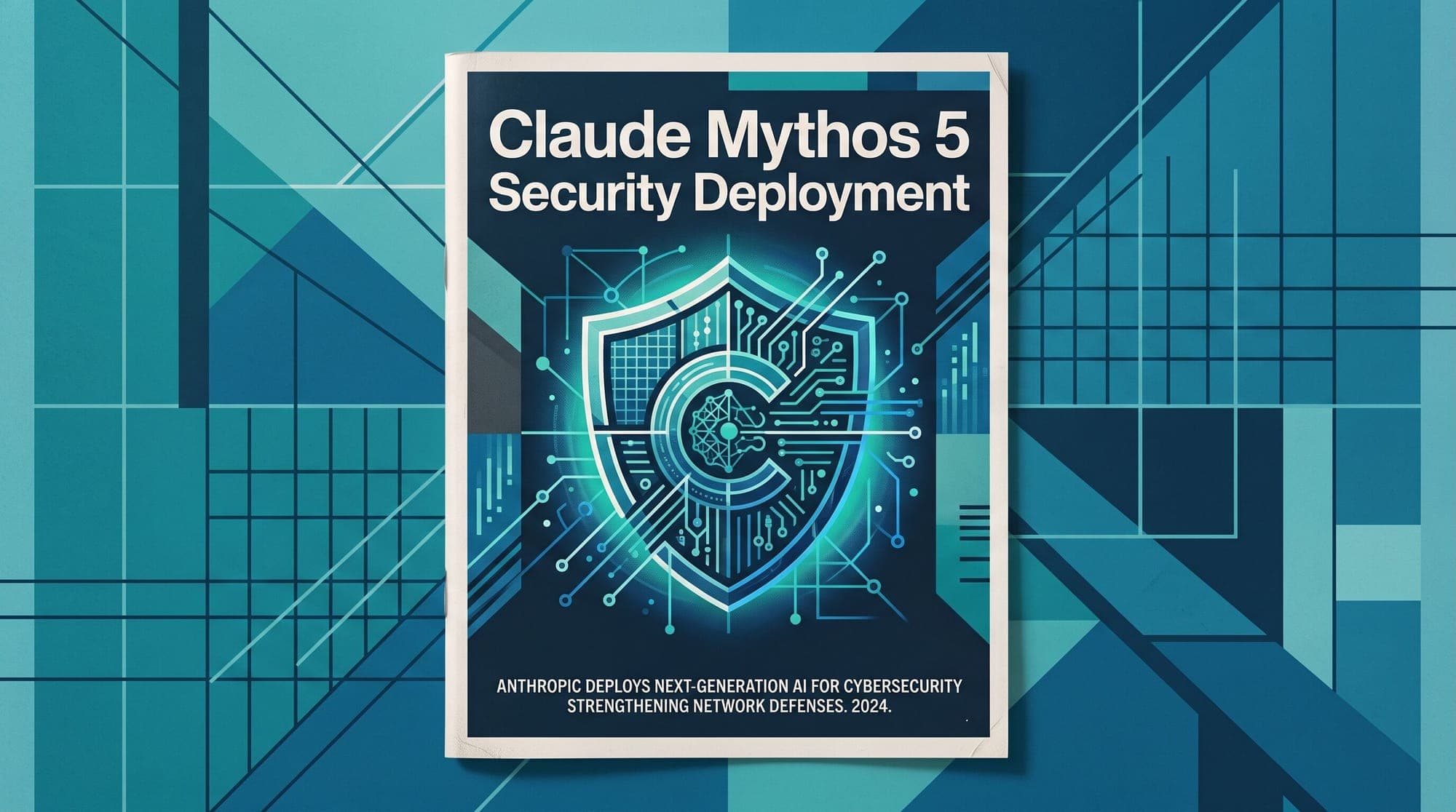
Illustration: Security shield with code vulnerability markers

Claude Mythos 5 is now running vulnerability scans in Claude Security for Enterprise customers, marking the third stage of Anthropic's deliberate rollout of its cyber-capable model.

Anthropic announced on August 21 that Claude Mythos 5, limited to vetted security defenders since April 2026, is now available for Enterprise customers to scan codebases for vulnerabilities. The company is also launching a $35 million Defender Advantage Fund (0xDAF) to distribute Claude credits to organizations securing open-source software.

How Claude Security Works

Enterprise customers enable Claude Security in the admin console and access it from claude.ai/security. Users pick a repository, and Mythos 5 scans the codebase for vulnerabilities with CWE categorization, confidence and severity ratings, and suggested fixes. The scanning process returns detailed findings rather than raw model outputs — limiting risk by not extending Mythos access to other surfaces.

The model costs $10 per million input tokens and $50 per million output tokens, less than half the price of Mythos Preview at $25/$125.

Security Partner Ecosystem

Anthropic is working with cybersecurity partners to integrate Mythos 5 into their products. End users of partner products never prompt Mythos 5 directly; purpose-built interfaces run the model in the background for defined tasks and return only intended artifacts. Partners include Wiz, Palo Alto Networks, CrowdStrike, and Accenture, among others.

Defender Advantage Fund

The $35 million fund will initially support larger pilot grants for:

  • Patching live vulnerabilities in widely used open-source projects
  • Automating scanning and patching at scale
  • Building defenses resistant to entire attack classes

Coordinated vulnerability-fixing efforts like Akrites and the White House's Gold Eagle initiative will receive support through the fund.

Project Glasswing Legacy

Mythos 5 follows Project Glasswing, launched in April 2026 with a coalition including Amazon Web Services, Microsoft, Google, CrowdStrike, and the Linux Foundation. Mythos Preview found thousands of high-severity vulnerabilities in major operating systems and web browsers, all reported and patched before disclosure.

Sources

Written by

More to read

  • OpenAI Consolidates Product Leadership Under Greg Brockman, Merging ChatGPT and Codex Teams

    OpenAI has executed an internal restructuring that consolidates its core product lines, engineering scaling, and commercial deployment under co-founder and President Greg Brockman. The reorganization merges the teams behind ChatGPT, the Codex coding agent, and developer APIs into a single unified product division. The move flattens decision-making hierarchies across the company as it prepares for an eventual initial public offering and responds to mounting enterprise competition from Anthropic

    1 min
  • Grammar-Constrained Decoding in Production: Finite State Automata, Pushdown Parsers, and Asynchronous Bitmasking

    Autoregressive language models generate text by sampling from a probability distribution over a discrete vocabulary at each step. While unconstrained sampling succeeds across open-ended text tasks, it offers no syntactic guarantees when producing machine-readable formats such as JSON, SQL, or structured tool calls. In automated agent loops, a single missing quotation mark, unbalanced bracket, or unescaped control character breaks downstream parser execution, forcing expensive retry round-trips.

    1 min
  • No Positional Embeddings (NoPE): How Causal Masking and Attention Geometry Encode Sequence Order

    A foundational tenet of the Transformer architecture established by Vaswani et al. (2017) is permutation equivariance. Because standard self-attention calculates token interactions purely through pairwise dot products across sets of vectors, shuffling the order of input tokens yields identical outputs up to the corresponding permutation. To establish word order, standard transformer models inject explicit positional information, ranging from learned absolute position embeddings (APE) to sinusoid

    1 min