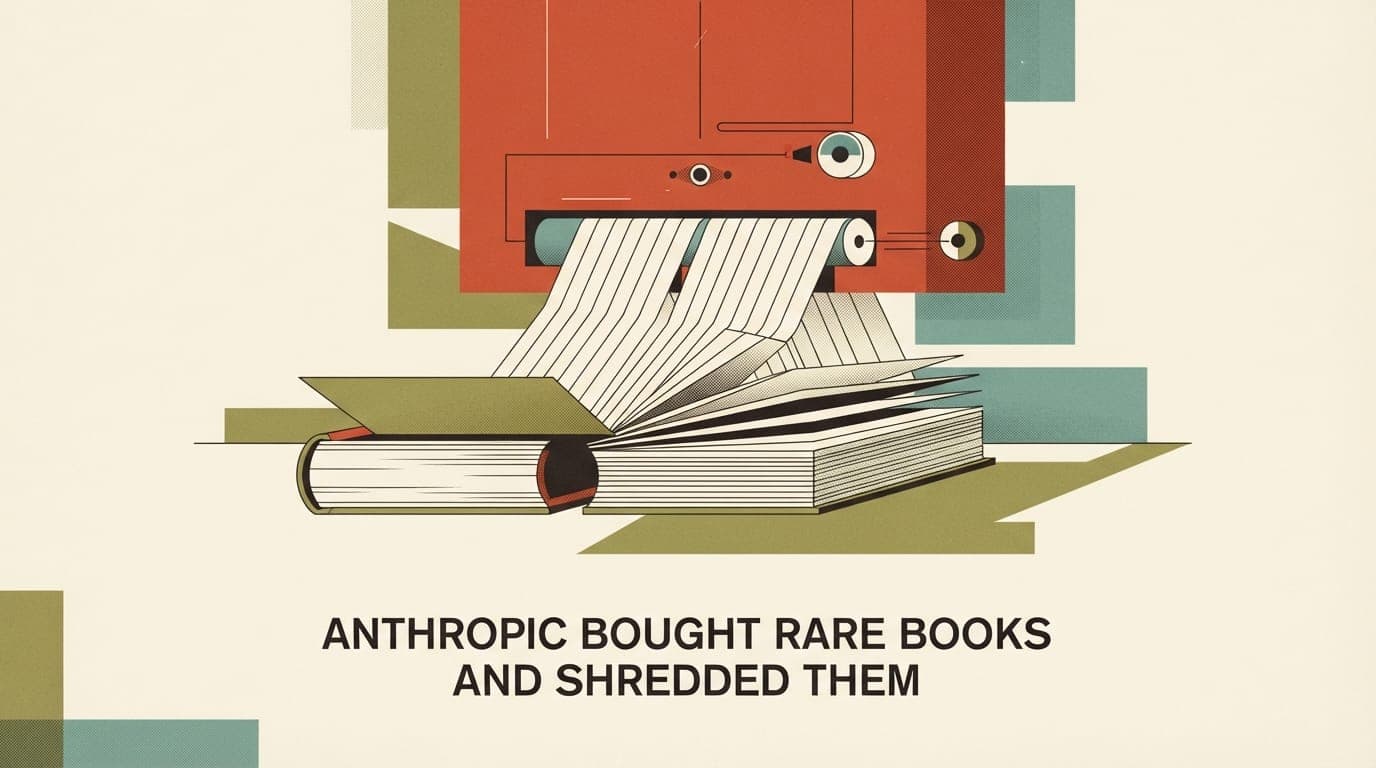
Court documents from the settled copyright lawsuit against Anthropic reveal that the company purchased physical books in bulk, used hydraulic cutting machines to remove their spines, scanned the pages with industrial equipment, and then destroyed the original copies. The practice, internally called Project Panama, targeted rare and out-of-print titles, including editions with few surviving copies.
What the documents show
According to reporting by Futurism and 404 Media, Anthropic hired Tom Turvey, a former Google Books executive, to lead bulk acquisition of physical books. The company bought volumes from resellers, sometimes through intermediary services like ISBNdb that facilitate anonymous orders of up to one million books at a time. Pre-2022 books were prioritized because they are free of AI-generated content.
Once acquired, each book had its binding removed with a hydraulic-powered cutting machine. Pages were scanned using high-speed industrial imaging equipment. The physical remains were then collected by a recycling company. The digital scans were used as training data for Claude models.
The legal rationale
A federal judge in San Francisco ruled that this process qualifies as fair use. The reasoning: Anthropic purchased each book legally, converted the physical copy into a single digital file, and destroyed the original. Because the digital file was not sold or redistributed, and the total number of copies in circulation did not increase, the court found the use quintessentially transformative.
The destruction of the physical book paradoxically strengthened Anthropic's legal position. If the original had remained on the market while Anthropic retained a digital copy, it could have constituted unauthorized reproduction. Destroying the physical copy meant only one version existed at any time, which the court treated as format conversion rather than duplication.
What happened to rare editions
The Washington Post uncovered details of Project Panama in January 2026 from over 4,000 pages of unsealed court documents. Reporting from the Dallas Express confirmed that some books entering the pipeline had very few surviving copies. Once shredded, those copies are gone permanently.
Services like ISBNdb broker large-volume book acquisitions for AI companies while keeping buyer identities anonymous. The scale of destruction is not publicly known, but the practice was operational across multiple years.
Public reaction
The details resurfaced in late July 2026 after a post on X by the account @HedgieMarkets, which cited the court filings and reporting from 404 Media. Investor Michael Burry responded with "Evil incarnate." Elon Musk said he had instructed the SpaceXAI team to preserve rare books in a library and "scan them the hard way vs just cutting off the spine and scanning."
David Sacks, chair of the President's Council of Advisors on Science and Technology, called the practice hypocritical: "Anthropic maintains that it is entitled to train for free on all the world's output, even if the author objects. But if a competitor trains on Anthropic's output after paying for it, that is IP theft."
The $1.5 billion settlement Anthropic agreed to in July covered claims related to pirated books used in training. The spine-cutting practice involved legally purchased books and was not part of the settlement claims.
Sources
Futurism: AI companies are buying antique books, ingesting their contents to train models, and then destroying them - https://futurism.com/artificial-intelligence/ai-companies-destroying-rare-books
Yahoo Finance / Stocktwits: Is Anthropic Destroying Rare Books After Training AI Models On Them? - https://finance.yahoo.com/technology/ai/articles/anthropic-destroying-rare-books-training-090104360.html
Dallas Express: Save Your Books: AI Companies Destroying Books For Training - https://dallasexpress.com/national/the-vanishing-page-ai-firms-scan-then-destroy-rare-book-editions
36Kr: Millions of Books Were "Burned After Reading" by Claude - https://eu.36kr.com/en/p/3920567021950855
NewsNation: AI companies, including Anthropic, accused of buying, ripping pages from books to train models - https://www.newsnationnow.com/business/tech/ai-anthropic-buying-destroying-books-train-lawsuit