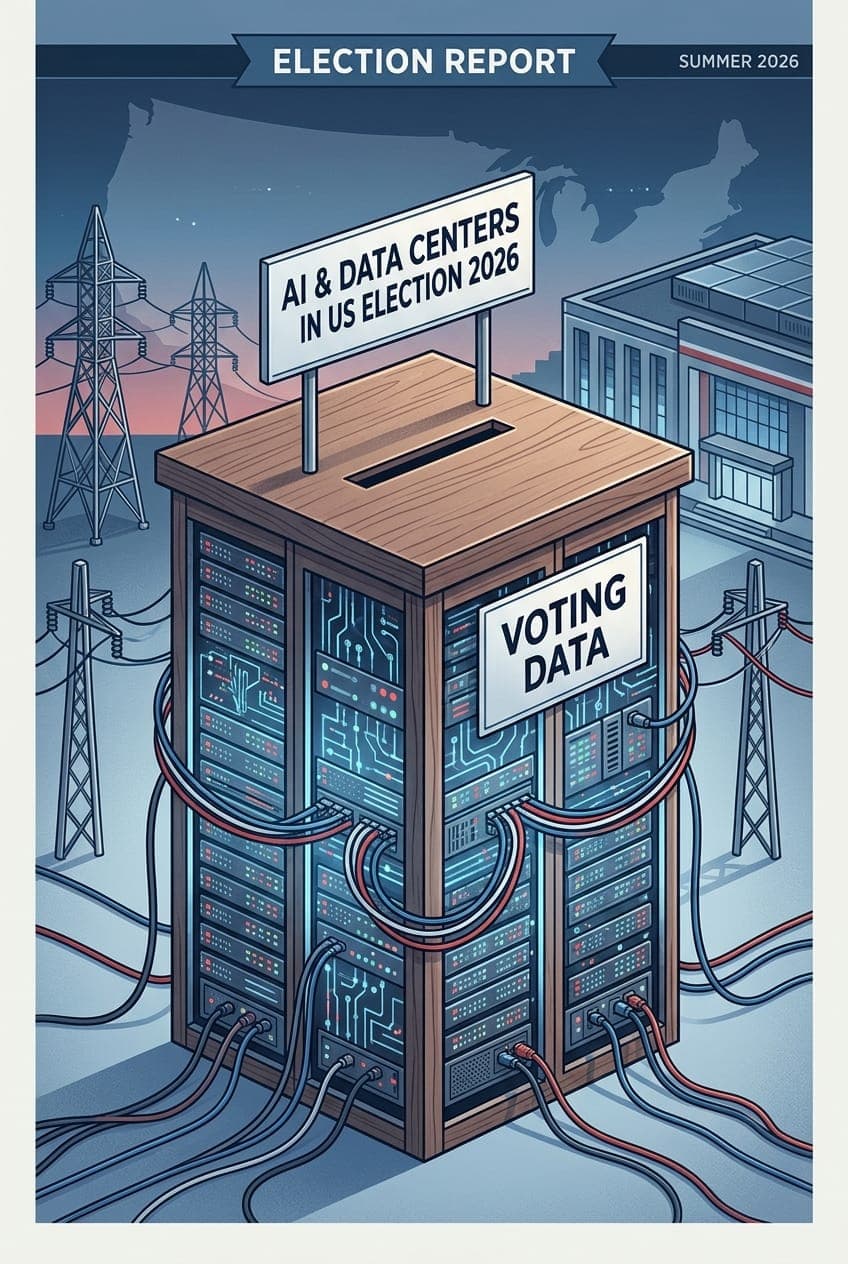
Artificial intelligence has become a major campaign issue across the United States, with data centers and their impact on local electricity costs, water use, and land use dominating the conversation. A Washington Post analysis of more than 1,200 websites from active candidates found AI appears in nearly 40 percent of all races for the House, Senate, and governor seats.
Democratic candidates bring up AI twice as often as Republicans, focusing on AI risks, regulation, and child safety. Republicans lean mostly on national security and competition with China. Separate polls show a majority of Americans are skeptical of AI and worry about job losses.
Data Centers as Lightning Rods

The conversation centers on data centers. Candidates of both major parties try to outdo each other with crackdowns on data center development, framing the infrastructure as a local burden. The concern is concrete: data centers consume vast amounts of electricity, strain local water supplies for cooling, and occupy large tracts of land.
Democratic candidates emphasize regulation and safety standards, while Republican candidates frame data centers as necessary for national competitiveness against China. Both parties agree that the current pace of data center construction needs oversight, creating a rare bipartisan consensus.
Local Impact Drives National Debate
In Virginia, Ohio, and Texas - states with major data center hubs - candidates have made AI infrastructure a signature issue. Local communities have raised concerns about noise, traffic, and strain on the electrical grid. These local fights are now shaping national messaging.
A candidate in Loudoun County, Virginia, home to one of the world's largest data center clusters, made data center regulation a central plank of their platform after residents complained about industrial development encroaching on suburban neighborhoods. Similar dynamics play out in Dublin, Ohio, and suburban Houston.
Bottom Line
For the first time in a U.S. election cycle, AI infrastructure is not a niche tech issue but a mainstream campaign topic with real local and national consequences. Data center siting, electricity costs, and the competition with China for AI leadership are now standard fare in candidate messaging from town halls to televised debates.
Sources
Washington Post: Shira Ovide, Clara Ence Morse, and Kevin Schaul, "AI becomes a major election issue for the first time, data shows" (Aug 14, 2026): https://www.washingtonpost.com/technology/2026/08/14/ai-becomes-major-election-issue-first-time-data-shows/
The Decoder: "AI and data centers have leapfrogged Israel, racism, and crypto as US campaign topics" (Aug 17, 2026): https://the-decoder.com/ai-and-data-centers-have-leapfrogged-israel-racism-and-crypto-as-us-campaign-topics/